DISC Workshops: Unlocking Team Dynamics And Communication In The Workplace
DISC workshops have become one of the most widely adopted tools for improving workplace relationships, communication, and team performance. Based on the DISC behavioral assessment model — which categorizes preferences into four primary styles: Dominance, Influence, Steadiness, and Conscientiousness — these workshops help individuals and teams understand their own behavioral tendencies and those of others. By making these patterns visible and actionable, DISC workshops create a shared language that reduces misunderstandings, improves collaboration, and strengthens overall team cohesion.
Unlike personality typing systems that focus on fixed traits, DISC emphasizes observable behaviors and how they show up in work environments. The model is deliberately practical and non-judgmental: no style is better or worse; each brings strengths and potential blind spots. When applied thoughtfully through a structured workshop, DISC becomes a powerful framework for self-awareness, empathy, and more effective interactions.
The Core Model Behind DISC Workshops
The DISC framework is built around four primary behavioral styles, each representing a different combination of two key dimensions: pace (fast vs. moderate) and priority (task vs. people).
- Dominance (D) reflects a direct, results-oriented style — people who prioritize outcomes, make quick decisions, and enjoy taking charge.
- Influence (I) describes an outgoing, people-focused style — expressive communicators who thrive on relationships, persuasion, and enthusiasm.
- Steadiness (S) represents a calm, patient, team-oriented approach — individuals who value consistency, support, and harmony.
- Conscientiousness (C) captures a detail-oriented, analytical style — people who emphasize accuracy, quality, planning, and structure.
Everyone exhibits all four styles to some degree, but most people have one or two that feel most natural. DISC workshops use a validated self-assessment questionnaire (typically 20–25 questions) to generate a personalized profile showing a person’s natural and adapted behaviors in the workplace. The real value emerges when teams see not just their own profiles but the full team map, revealing how styles interact, where natural synergies exist, and where friction is likely to arise.
Typical Structure of a Well-Run DISC Workshop
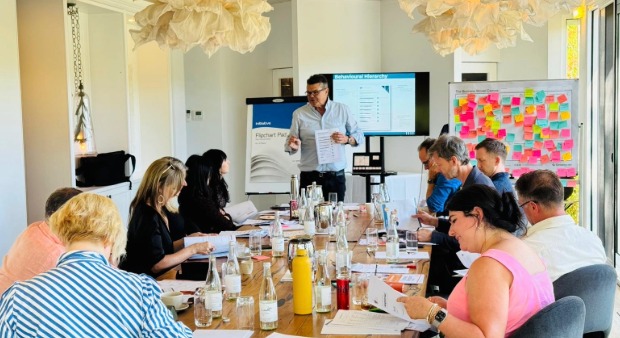
A standard DISC workshop lasts between half a day and two full days, depending on group size, depth required, and whether it includes team-specific application work.
The session usually opens with an explanation of the DISC model, its history, and the four styles, ensuring everyone starts from the same foundational understanding. Participants then receive and review their individual profiles — often in a safe, non-judgmental setting — and reflect on how the results align with their self-perception and daily behavior at work.
The facilitator guides the group through interactive exercises that highlight differences in communication preferences, decision-making styles, response to pressure, and approach to conflict. Common activities include role-plays showing how the same message lands differently depending on the recipient’s style, group discussions on real workplace scenarios, and mapping the team’s collective DISC profile to identify overall strengths and potential blind spots.
Later stages shift from awareness to application: participants practice adapting their style to better connect with colleagues, managers, or direct reports whose preferences differ from their own. Many workshops end with action planning — specific, measurable commitments to change one or two behaviors in the coming weeks or months.
Benefits for Individuals Attending DISC Workshops
For participants, the experience often delivers immediate clarity and longer-term practical value.
Many people report an “aha” moment when they see their profile and realize why certain interactions feel energizing while others drain them. Understanding natural preferences helps explain why they gravitate toward particular tasks, communication methods, or decision-making speeds — and why they sometimes clash with colleagues who operate differently.
The model also highlights adaptive behaviors: how people naturally adjust their style in the workplace to meet expectations or avoid conflict. Recognizing these adaptations often reduces self-criticism (“Why do I always have to be the one who compromises?”) and builds self-acceptance. At the same time, learning to flex deliberately — speaking more concisely to a D-style colleague or providing more detail to a C-style team member — becomes a conscious, repeatable skill.
Over time, individuals who apply DISC insights tend to experience less friction, stronger working relationships, and greater confidence in handling diverse personalities.
Team-Level Impact of DISC Workshops
The real power of DISC emerges when an entire team or department experiences the workshop together. Seeing the collective profile — often displayed as a team wheel or bar chart — reveals patterns that explain recurring dynamics: why decisions sometimes stall, why some voices dominate while others stay quiet, why feedback is sometimes taken personally, or why certain projects feel smoother than others.
Teams with a heavy concentration of one style often discover blind spots. A team full of high-D individuals may move fast but overlook details or alienate quieter members. A group dominated by high-S styles might be harmonious but slow to act. Understanding these tendencies allows teams to intentionally balance their approach: assigning roles that play to natural strengths, creating communication norms that accommodate different preferences, and building processes that compensate for collective weaknesses.
Post-workshop, many teams report improved meeting efficiency, clearer delegation, faster conflict resolution, and a more inclusive atmosphere. The shared language (“I’m adapting to your S-style here”) reduces defensiveness and makes difficult conversations easier.
Common Applications and Use Cases
Organizations deploy DISC workshops in a variety of contexts:
- New team formation or team resets after restructuring
- Leadership development programs for first-line managers and emerging leaders
- Sales and customer-facing teams to improve client communication
- Conflict resolution or post-merger integration
- Improving cross-functional collaboration
Supporting diversity, equity, and inclusion initiatives by highlighting behavioral diversity
The model’s neutrality makes it particularly effective in mixed groups — it avoids labeling people as “good” or “bad” and focuses instead on observable preferences and their practical impact.
Realistic Expectations and Best Practices
DISC workshops deliver the strongest outcomes when expectations are realistic and the program is well-facilitated.
The assessment is not a personality test — it measures observable behavior preferences in a work context, not innate traits. Results can shift slightly depending on life stage, role, or stress level, and that fluidity is normal.
The workshop itself is not a one-off fix; sustainable change requires follow-up. Teams that revisit their profiles periodically, reference the language in meetings, and coach each other on style adaptation see the longest-lasting impact.
Facilitator quality matters enormously. A skilled practitioner creates psychological safety, handles diverse reactions gracefully, and translates insights into practical next steps. A poor facilitator can leave participants feeling labeled or defensive.
Finally, the model works best when positioned as a tool for understanding and adapting — not for boxing people in or excusing behavior.
Conclusion: A Practical Tool for Better Working Relationships
DISC workshops remain one of the most widely used and enduring team-development interventions because they are simple, practical, non-judgmental, and immediately applicable. They give teams a shared vocabulary for discussing differences without blame, help individuals understand their own default settings, and provide concrete strategies for adapting in real time.
In organizations where collaboration, communication, and emotional intelligence are essential for success, investing in a well-run DISC workshop can produce returns far beyond the initial session. Relationships improve, misunderstandings decrease, productivity rises, and people feel more seen and understood — all of which contribute to stronger teams and healthier workplaces.
If your team is experiencing friction, unclear roles, communication breakdowns, or simply wants to perform better together, a thoughtfully delivered DISC workshop is often one of the most effective and affordable interventions available. The model doesn’t change people — it helps them understand each other better, and that understanding is often the starting point for real and lasting change.