Bugonia's Ending Is Either Brilliant Or A Total Cop-Out And Here's Why Both Views Are Valid

The final ten minutes of Bugonia have sparked one of the year's most heated cinematic debates. After spending two hours trapped in a basement with conspiracy theorist Teddy Gatz and kidnapped CEO Michelle Fuller, the film reveals that yes, Michelle really is an alien from Andromeda. She boards her mothership, determines humanity has failed, and casually erases nine billion people with the emotional weight of closing a browser tab. The world stops. Bodies drop where they stood. The bees return to their hives.
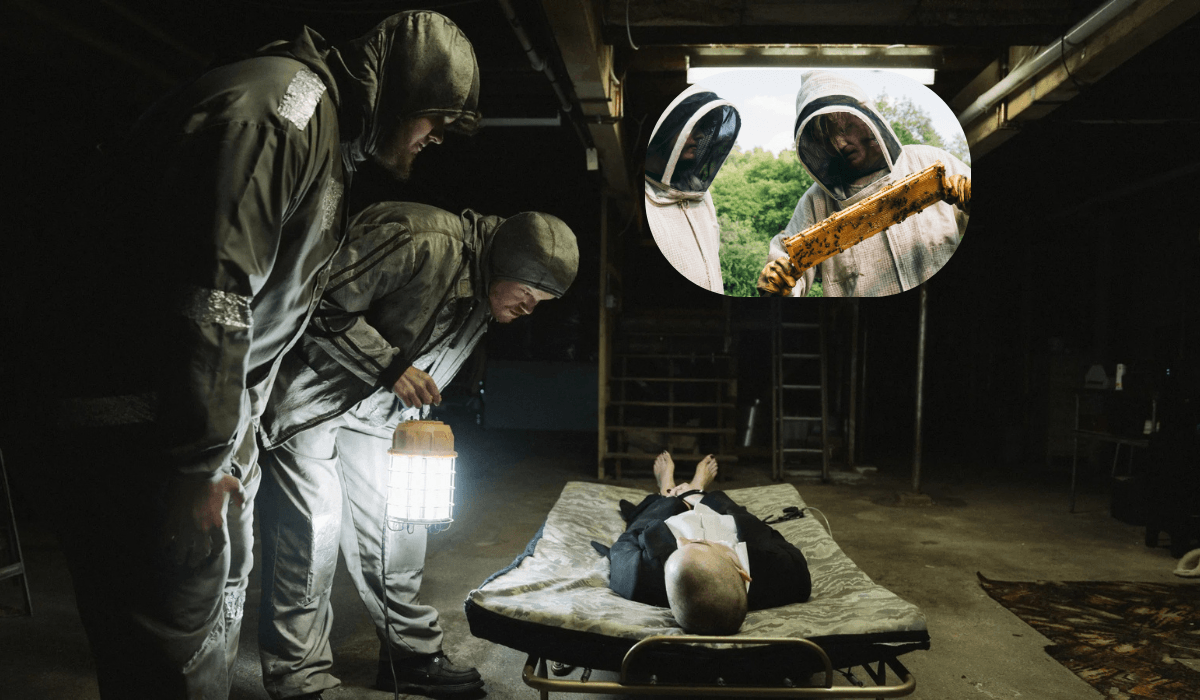
Some viewers call it genius. Others consider it a betrayal. Both camps are onto something important, and the divide reveals more about us than the film itself.
What Actually Happens in Those Final Moments
Before diving into interpretation, let's establish the facts. After Teddy's cousin Don tragically shoots himself in despair, unable to reconcile his guilt over Michelle's torture with his loyalty to Teddy, Michelle seizes her opportunity. She convinces Teddy she's been hiding the cure for his mother's illness in antifreeze stored in her car trunk.
Teddy, desperate and gullible when told what he wants to hear, rushes to his mother Sandy's long-term care facility and feeds antifreeze into her IV line. He kills his own mother believing he's saving her. When he returns and realizes Michelle's deception, she shifts tactics completely.
Michelle now claims to be exactly what Teddy suspected all along. She's Andromedan royalty, here to observe humanity, and she'll take him to negotiate with her people aboard the mothership. They go to her corporate office, where Teddy's explosive vest accidentally detonates, killing him. Michelle escapes the ambulance rushing her to the hospital and returns to the office.
Using a calculator as a communication device, exactly as Teddy had sketched in his conspiracy diagrams, Michelle beams herself to the Andromedan ship. She consults with her advisors, studies a model of Earth encased in a protective bubble, and makes her judgment. Humanity has failed. She pops the bubble.
Cut to an extended montage set to Marlene Dietrich's haunting version of "Where Have All the Flowers Gone." People worldwide collapse instantly. No blood, no violence, just cessation. A man mowing his lawn. A couple having sex. Children in a schoolroom. Office workers at their desks. All stopped like someone pulled the plug on a simulation.
The final shot shows bees returning to their hives, suggesting nature will flourish without us. Michelle watches from above, tears streaming down her face. Roll credits.
The Case for Why This Ending Is Brilliant
Let's start with the defense, because this interpretation has genuine merit. The ending works as a devastating critique of exactly where we are culturally in late 2025.
Screenwriter Will Tracy has been explicit about his intentions. In interviews with multiple outlets, he's explained that the ending isn't meant to be taken literally as a prediction. It's a warning, a mirror held up to show us what we're risking if we continue on our current trajectory. He told Den of Geek that a truly bleak ending would say "it's always going to be like that," but Bugonia's conclusion is constructive because "this hasn't happened, and it will not happen."
The brilliance lies in how the film forces viewers to sit with the consequences of our collective behavior. Teddy represents radicalized internet conspiracy culture taken to its logical extreme. He's not entirely wrong about corporate malfeasance. Michelle's pharmaceutical company Auxolith really did destroy his mother's brain with an experimental drug. The film never denies that legitimate corporate harm exists.
But Teddy's methods are monstrous. He kidnaps, tortures, and murders innocent people. He dissects Andromedans he captures, treating sentient beings as lab specimens. His quest for truth becomes an excuse for cruelty, and that cruelty ultimately dooms humanity. Michelle makes her final judgment based specifically on what Teddy does to her and the other Andromedans she finds dissected in his basement.
This creates a genuinely profound moral dilemma. Was Teddy right to suspect Michelle? Absolutely. Were his actions justified by that correctness? Absolutely not. The ending suggests that even when conspiracy theorists identify real problems, their violent extremism can make things catastrophically worse.
Director Yorgos Lanthimos has noted that audience reactions split dramatically. Some find the ending hopeful because nature survives. The bees, Teddy's only genuine connection to anything beyond himself, are saved. Earth gets a second chance without the species destroying it. That's not nihilism. That's cautious optimism about what might emerge from our absence.
The visual design of those final death tableaux matters enormously. These aren't anonymous corpses in a disaster movie. They're individuals captured in mundane moments. Some are doing harm, others are doing good, most are just existing. The film presents the full spectrum of human experience without judgment, asking us to recognize what would be lost.
Tracy emphasized this in interviews, explaining that unlike the Korean original Save the Green Planet, which ends with Earth exploding completely, Bugonia spares the planet itself. Only humans are removed. That distinction carries weight. We're not inherently destructive. Our systems and behaviors are.
The ending also rewards careful viewing. Michelle's calculator as a communication device, the specific way she describes Andromedan technology, the model of Earth on the ship, all these details match Teddy's earlier sketches and theories. The film has been foreshadowing this revelation throughout, trusting attentive viewers to piece together clues.
Emma Stone's performance in those final moments adds crucial ambiguity. She cries as she destroys humanity. Are those tears of genuine grief for what she's about to do, or satisfaction at finally being free to act? The film doesn't tell us, leaving space for viewers to project their own interpretation based on everything they've seen of her character.
The Case for Why This Ending Fails
Now let's address why many viewers, including some critics, find the ending problematic or even irresponsible.
The timing matters immensely. Bugonia arrives in a cultural moment when conspiracy theories have escaped the internet's fringes to influence actual policy. QAnon adherents hold public office. Vaccine misinformation kills people. Election denial threatens democracy. In this context, a film that validates its conspiracy theorist protagonist, even partially, carries dangerous implications.
Paste Magazine published one of the most compelling critiques, arguing that the ending "defangs too much of its satire" and opens the door to misinterpretation. The piece points out that in 2003, when Save the Green Planet premiered, depicting conspiracy theorists could still be lighthearted because everyone understood it was satire. In 2025, that shared understanding no longer exists.
The concern isn't that every viewer will literally believe in Andromedan aliens. The problem is that the film's structure validates the core conspiracy theorist worldview: trust no one, the elites really are lying, your paranoia is justified, violence in pursuit of truth is acceptable if you turn out to be correct.
Teddy tortures Michelle for hours. He murders innocent people he suspects might be aliens. He dissects living beings. The film depicts all this as horrifying, yes, but then reveals he was fundamentally right about Michelle's identity. That creates a troubling equation where the ends justify the means.
Some viewers will inevitably take away the message that Teddy's methods, while regrettable, were necessary to expose the truth. If Michelle really was an alien planning humanity's destruction, doesn't that retroactively justify his actions? The film tries to complicate this reading, but it's not clear the complications land for everyone.
The predictability also undermines the intended impact. Many viewers report figuring out the twist halfway through the film. The foreshadowing, meant to reward careful viewing, instead telegraphs the reveal so obviously that it loses surprise. If you've seen The Twilight Zone or any number of similar stories, the "conspiracy theorist was right" ending is familiar territory.
This predictability creates a secondary problem. If the twist is obvious, then spending two hours watching torture and basement captivity feels less like building tension and more like marking time until the inevitable reveal. The middle section, which should be taut with uncertainty about Michelle's true nature, becomes tedious when you're already reasonably certain where it's heading.
There's also the question of whether the film actually says anything new. Yes, corporations do harm. Yes, conspiracy theories emerge from real grievances. Yes, online radicalization is dangerous. Yes, we're destroying the planet. Bugonia presents all these ideas but doesn't necessarily illuminate them beyond what we already know.
The ending's ambiguity, meant to be thought-provoking, can instead feel like the film avoiding taking a clear position. Is Michelle a tragic figure forced to judge humanity based on our worst representative? Or is she a cold manipulator who was always planning our extinction? The film refuses to answer, which you can read as sophisticated moral complexity or as a failure to commit to meaning.
Where Both Interpretations Meet: The Problem of Context
Here's what's genuinely fascinating about this debate. Both readings are textually supported. The film intentionally creates space for multiple interpretations. Lanthimos has said explicitly that viewer reactions reveal more about the viewer than the film.
The problem is that artistic ambiguity exists in cultural context, not in a vacuum. A film can be simultaneously well-crafted on its own terms and potentially harmful in how it will be received and used.
Consider how different audiences will process Bugonia's ending. Film critics and Lanthimos fans, primed to read his work as sophisticated satire, will likely grasp the intended critique of both corporate power and conspiracy culture. They'll appreciate the moral ambiguity, the refusal of easy answers, the way the film implicates everyone.
But what about viewers who already believe in deep state conspiracies, who already distrust all institutional authority, who already think violence might be necessary to expose hidden truths? For them, Bugonia could function as accidental validation. Look, the film says, sometimes the crazy people are right and the respectable authorities really are covering up world-altering secrets.
This isn't hypothetical concern-trolling. We've seen how media gets reinterpreted by audiences in ways creators never intended. Fight Club became an incel manifesto. The Joker became a folk hero. American Psycho's satire of toxic masculinity gets cited approvingly by exactly the men it's critiquing.
Bugonia's ending is sophisticated enough to resist simplistic readings if you're paying attention, but culture doesn't reward paying attention. Clips will circulate on social media. Summaries will reduce the film to "conspiracy theorist was right about aliens." The nuance will evaporate in transmission.
The Ending Works Artistically But Fails Culturally
After sitting with Bugonia twice and reading extensive commentary from all sides, I've landed somewhere uncomfortable. I think the ending is genuinely well-crafted filmmaking that nevertheless represents a misjudgment about its cultural moment.
Let me break this down precisely because it's important.
As pure cinema, the ending is effective. The visual design of those death tableaux is haunting. Jerskin Fendrix's paranoid score pays off perfectly. Emma Stone's ambiguous final expression creates productive uncertainty. The way the film has seeded clues throughout means the reveal doesn't come from nowhere, even if it's predictable.
The thematic complexity is real, not imagined. Bugonia genuinely does implicate everyone. Teddy is both victim of corporate harm and perpetrator of horrific violence. Michelle is both innocent captive and representative of systemic destruction. The film refuses to let anyone off the hook, which is more challenging than simply picking a side.
But artistically successful doesn't mean culturally wise, and this is where my criticism becomes sharper.
Lanthimos and Tracy made this film in 2024 and 2025, after years of watching conspiracy theories metastasize from internet curiosities into genuine threats to democratic governance and public health. They made it after January 6th. After vaccine misinformation killed hundreds of thousands. After QAnon wormed its way into mainstream Republican politics.
In this context, making a film where the conspiracy theorist turns out to be fundamentally correct strikes me as tone-deaf at best, irresponsible at worst. Yes, the film complicates that revelation. Yes, it shows Teddy's methods as monstrous. But those complications require a level of media literacy and critical engagement that we cannot assume exists universally.
The defense that "this is meant as a warning, not a validation" doesn't fully satisfy me. Intention matters less than reception, and the film has structured itself in ways that make misreading not just possible but likely for certain audiences.
Compare this to The Menu, Tracy's previous screenplay. That film also critiqued both elites and the people who obsess over them, but it maintained clearer moral ground. The chef's murders were wrong regardless of how insufferable his victims were. The film never suggested he was justified. Bugonia muddles that clarity by making Michelle actually be what Teddy accuses her of being.
Here's my core objection, and it's one I keep returning to. The film didn't need Michelle to be a real alien for its themes to work. Imagine if the ending revealed she was just a ruthless human CEO, exactly as she appears. Teddy dies in his explosive vest, convinced to the end that he was saving humanity. We're left with the tragedy of his wasted potential, the genuine harm Michelle's company caused, and the way conspiracy thinking transforms legitimate grievances into self-destructive delusion.
That ending would preserve all the film's thematic richness while avoiding the validation problem. It would be genuinely subversive, denying the audience the satisfaction of discovering hidden truth. It would force us to sit with the more uncomfortable reality that sometimes there is no grand conspiracy, just banal evil perpetrated by ordinary humans in boardrooms.
Instead, Bugonia chooses the twist, and that choice bothers me. It feels like Lanthimos and Tracy wanted to have it both ways: to critique conspiracy culture while also indulging in conspiracy narrative structure. That tension is interesting on paper but messy in execution.
The Technical Excellence Can't Be Denied
Regardless of how you feel about the ending's implications, the filmmaking itself is undeniably accomplished. Robbie Ryan's cinematography throughout those final sequences is stunning. The way he shoots the death montage, with each vignette composed like a Renaissance painting, gives weight and dignity to anonymous lives.
The decision to spare animals and nature reads clearly on screen. We see the bees returning to their work, birds taking flight, a world that continues without us. That visual clarity matters for viewers who find hope in the ending.
Emma Stone's performance in those final moments is masterful. Watch her face as she makes the decision to destroy humanity. There's grief there, but also something harder to define. Relief? Resignation? Satisfaction? Stone plays it so that multiple readings remain valid simultaneously.
The Marlene Dietrich song choice is inspired. "Where Have All the Flowers Gone" is a folk anti-war song about cycles of violence and senseless death. Using Dietrich's world-weary German-accented version adds historical weight. This isn't just humans dying, it's the culmination of everything we've been building toward since we learned to wage war.
The pacing of the ending matters too. Lanthimos doesn't rush it. We spend several minutes watching those death tableaux, enough time to actually process what we're seeing rather than treating it as a quick shock beat. The stillness and silence create genuine reflection space.
Why the Debate Itself Validates the Film
Here's where I'll give Lanthimos and Tracy their due. The fact that Bugonia's ending generates such passionate disagreement suggests it's doing something right. Art that everyone agrees about is usually playing it safe, and whatever Bugonia is doing, it's not that.
The ending forces conversations about responsibility, about what artists owe their audiences, about whether ambiguity is sophistication or evasion. These are valuable conversations to have, even if they're frustrating.
I've watched friends argue about Bugonia for hours. Some insist it's dangerous conspiracy-validating garbage. Others claim it's the most incisive political satire of the year. Both camps are engaging seriously with the film's ideas rather than dismissing it. That engagement matters.
The split between critics (87% on Rotten Tomatoes) and some vocal portions of the audience speaks to the film successfully challenging expectations. Not all challenges land perfectly, but the attempt itself has value.
Lanthimos has also noted in interviews that some viewers initially find the ending bleak but later reconsider and see hope. If the film genuinely sticks in people's minds enough to prompt that kind of evolving interpretation, it's achieving something most movies don't even attempt.
The Save the Green Planet Comparison Adds Important Context
Understanding Bugonia requires knowing its relationship to the 2003 Korean original. Jang Joon-hwan's film ends with Earth literally exploding. The alien king declares humanity failed, and everything, including animals and the planet itself, is destroyed. The final image is a TV floating through space playing VHS tapes of the protagonist's childhood.
That ending is unambiguously nihilistic. There's no hope, no second chance, no suggestion that nature might flourish. It's pure apocalyptic despair.
Bugonia softens this considerably. By sparing the planet and animals, by showing the bees returning to their work, by having Michelle cry as she makes her decision, the remake adds layers of potential hope that the original didn't contain.
Some critics argue this makes Bugonia's ending weaker, that it's pulling punches the original committed to fully. Others see it as Lanthimos and Tracy adapting the material for contemporary concerns about environmental collapse. We're not worried about losing everything, we're worried about losing specifically human civilization while the planet recovers without us.
That distinction matters thematically. The Korean original was made in 2003, before climate change dominated cultural consciousness the way it does now. Bugonia arrives in 2025, when "humanity destroys itself but nature survives" is practically its own genre of eco-apocalyptic fiction.
Whether that adaptation succeeds depends largely on how you read the ending's tonal balance. Is the survival of nature genuinely hopeful, or is it just a way of softening what should be uncompromising nihilism?
What Bugonia Gets Right About Our Moment
Despite my reservations about the ending's cultural implications, I have to acknowledge what the film captures brilliantly about where we are right now.
The dynamic between Teddy and Michelle perfectly encapsulates contemporary discourse. Both believe they're correct. Both believe they're morally superior. Both have evidence supporting their worldview. Neither can truly hear what the other is saying because they're too invested in their own narrative.
As one reviewer noted, it's like watching a Facebook comment section play out in real time. That observation is devastatingly accurate. We've all seen these arguments, where both parties talk past each other because they're operating from incompatible frameworks of what constitutes truth and evidence.
Bugonia also captures how conspiracy theories emerge from legitimate grievances. Teddy's not wrong that Auxolith harmed people. The pharmaceutical industry really does prioritize profit over safety sometimes. But the leap from "corporations do harm" to "therefore they must be alien infiltrators" is where rational criticism becomes delusional extremism.
The film understands that distinguishing between those two states has become nearly impossible in our current information environment. When actual conspiracies do exist, when powerful people really do lie, when systems really are rigged, how do you maintain healthy skepticism without sliding into paranoid conspiracy thinking?
Bugonia doesn't solve this problem because it's unsolvable. But it depicts the problem with uncomfortable clarity, which is more than most films attempt.
The Performance Dynamics Add Crucial Texture
One aspect that keeps getting lost in ending debates is how much Emma Stone and Jesse Plemons's performances complicate any simplistic reading.
Stone plays Michelle as simultaneously sympathetic and monstrous. When she's being tortured, your heart breaks for her. When she manipulates Don into suicide, you recoil at her cruelty. When she cries while destroying humanity, you genuinely can't tell if she's grieving or satisfied. Stone refuses to make Michelle easy to categorize.
Plemons matches her ambiguity with Teddy. He's pathetic and terrifying in equal measure. His love for his bees feels genuinely tender. His violence toward Michelle is sickening. His paranoid worldview is both recognizable and alien. Plemons never lets you forget that Teddy is a human being, not a monster, which makes his actions more disturbing rather than less.
The dinner scene halfway through the film exemplifies this. Teddy tries to negotiate with Michelle as if she's Andromedan royalty deserving respect. It's simultaneously absurd and heartbreaking. He genuinely believes he's conducting diplomacy while torturing a kidnapped woman. The scene is darkly funny and deeply sad at the same time.
These performances ensure that even if you hate the ending, the journey getting there remains compelling. You're watching two masterful actors work at the peak of their abilities, finding grace notes in a scenario that could easily have been one-dimensional.
Where I Land: Respect Without Endorsement
After extensive reflection, here's my final position. Bugonia's ending is technically accomplished, thematically ambitious, and ultimately a miscalculation given its cultural moment.
I respect what Lanthimos and Tracy attempted. They wanted to make a film that refused easy answers, that implicated everyone, that forced viewers to examine their own assumptions about truth and authority. Those are worthy goals.
But I think they underestimated how their ending would be received in 2025's toxic information environment. The reveal that Michelle really is an alien validates conspiracy thinking in ways that the film's complications can't fully contain. No matter how much the film shows Teddy's methods as monstrous, the basic fact remains: he was right when everyone thought he was crazy.
That's a dangerous message right now, regardless of artistic intention.
I also think the ending is somewhat predictable for attentive viewers, which undermines its impact. If you've already guessed the twist, the final reveal lands with a thud rather than a shocking revelation. The film needed either better misdirection or a different ending entirely.
That said, I don't regret watching Bugonia. It's provoked more sustained thought and conversation than most films I've seen this year. The performances are extraordinary. The cinematography is beautiful. The thematic ambition deserves recognition even in failure.
The ending doesn't ruin the film, but it prevents Bugonia from achieving true greatness. It settles for being very good and very frustrating when it could have been genuinely transcendent with different final choices.
Why This Debate Will Continue
Bugonia's ending will likely be argued about for years, and that's probably what Lanthimos intended. Films that generate this much disagreement tend to have longer cultural shelf lives than consensus crowd-pleasers.
The debate also reflects larger arguments we're having about art's responsibilities. Should films avoid certain narratives because they might be misused? Or does that amount to censorious hand-wringing that underestimates audience intelligence? Can something be artistically successful but culturally harmful? Where's the line between challenging audiences and validating dangerous beliefs?
These aren't abstract questions. They matter for how we navigate an information environment where fiction and reality blur constantly, where media literacy is declining, where conspiracy theories kill people.
Bugonia doesn't resolve these tensions. It instead stages them as cinema, forcing viewers to wrestle with exactly how we should interpret ambiguous endings in politically fraught times. That's valuable work, even when it's imperfect.
My recommendation? Watch Bugonia, let the ending sit with you, talk about it with people who disagree with your interpretation. The discomfort and debate are part of the experience. Just don't expect easy answers, clear heroes, or simple catharsis. The film refuses all those things, for better and worse.
Stream it now on Peacock and decide for yourself whether Lanthimos stuck the landing or fumbled at the goal line. Both views are defensible. Both say something important about how we watch films in 2025. And maybe that unresolvable tension is the real point.
Related Reads: Why Bugonia's Portrait Of Corporate Evil Feels More Terrifying Than Any Horror Movie