
Does anyone else find it interesting that the web novel actually finished in July 2025 but the manhwa is still ongoing? So technically we already know how the full story ends, we're just waiting on the visual adaptation to catch up.
9
Sign up to see more
SignupAlready a member?
LoginBy continuing, you agree to Sociomix's Terms of Service, Privacy Policy

Does anyone else find it interesting that the web novel actually finished in July 2025 but the manhwa is still ongoing? So technically we already know how the full story ends, we're just waiting on the visual adaptation to catch up.
The constellation system in ORV basically predicted how social media audiences consume content. Watching powerful beings sponsor humans for entertainment value hits differently in 2025 than it probably did when the story was written.
The manhwa community has been buzzing with anticipation ever since MAPPA Studio announced their adaptation of Omniscient Reader's Viewpoint. With a spring 2026 release date confirmed and 24 episodes planned for the first season, this adaptation represents one of the most ambitious manhwa-to-anime projects ever undertaken. But what makes this series so special that it warranted such a massive production commitment? If you're hearing about Omniscient Reader's Viewpoint for the first time or wondering whether the hype is justified, this guide will prepare you for what promises to be one of the biggest anime releases of the year. We'll cover the story premise, why it's captured millions of readers worldwide, what MAPPA's involvement means, and everything else you need to know before the first episode airs

Hot take but Jooheon is actually a better protagonist than Sung Jinwoo. Jinwoo just gets stronger in a straight line. Jooheon schemes, manipulates, and outsmarts everyone, which makes every arc feel like a chess match instead of a power level tournament.
The Gen-4 Turbo option for rapid iteration is underrated in this writeup. When you are testing a dozen different concept directions, speed matters more than peak quality. Turbo lets you find the right direction before committing to a full render.
Debugging AI-generated code is genuinely harder than debugging code you wrote yourself. You did not make the decisions, so you do not have the mental model for why the component is structured the way it is. That is a real cost the article does not mention.
One thing nobody mentions: the transcript is searchable. When you have 200 episodes of a podcast you can search for any word or phrase and jump directly to that moment across your entire archive. That use case alone is worth the subscription.
The $4 billion valuation is honestly still hard to wrap my head around. They basically turned PowerPoint energy into a billion dollar category.
My favorite part of this whole story is that it took eight years to find product-market fit and then five months to 10x revenue. Persistence absolutely met timing here.
Anyone else think the pricing model with credits and tiers is still the biggest barrier to mainstream adoption? Non-technical users do not want to think about generation queues and credit limits.
The detail that Claude is the only frontier AI available on all three major clouds simultaneously is a distribution advantage that barely gets mentioned. AWS Bedrock, Google Vertex, and Microsoft Azure Foundry. That's where enterprise developers already live.
From zero to 30 billion ARR in roughly two years. I've worked in enterprise software for over a decade and this genuinely does not have a historical comparison. Nothing in traditional SaaS scaled this way.
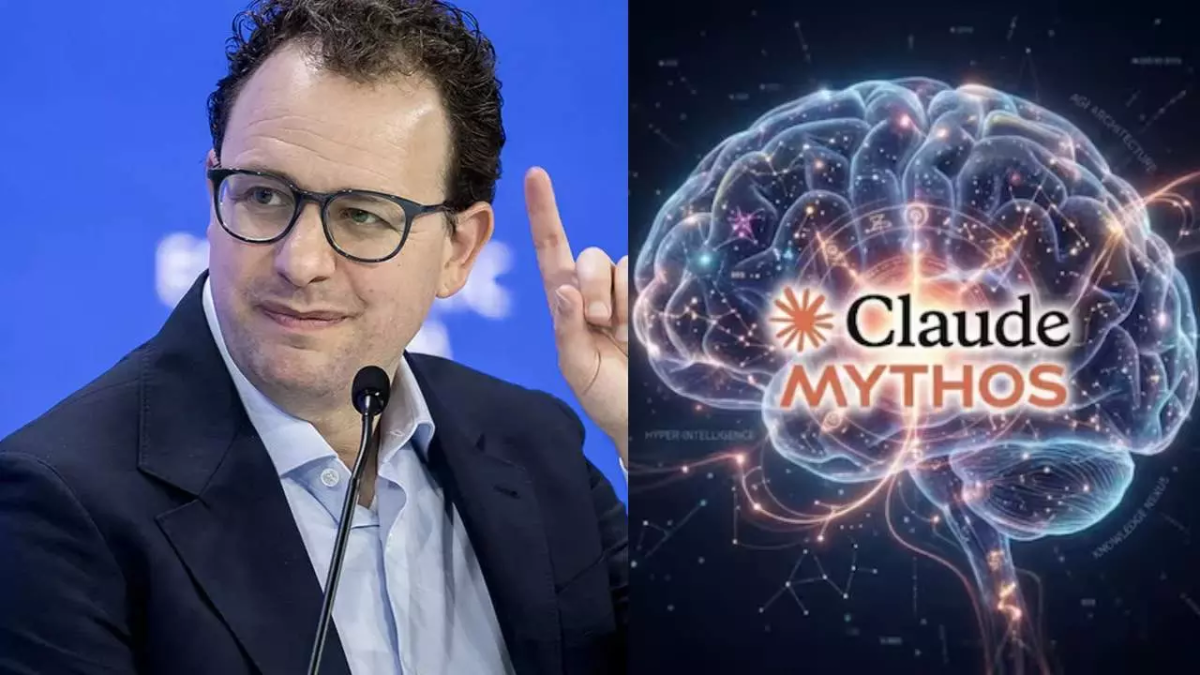
Anthropic on Tuesday unveiled an advanced artificial intelligence model designed specifically to identify software vulnerabilities, marking a significant development in the intersection of AI and cybersecurity. The model, named Claude Mythos Preview, will be available exclusively to a carefully selected group of companies as part of Project Glasswing, a new security initiative that aims to strengthen digital defenses while preventing malicious exploitation. The San Francisco based AI company has chosen to severely restrict access to Claude Mythos Preview due to its powerful capability to detect security weaknesses and software flaws. This decision reflects growing concerns about dual use AI technologies that could be weaponized by adversaries if they fell into the wrong hands.
The whole AI chip conversation always focuses on the compute side and ignores memory. Modern AI accelerators are almost always memory bandwidth limited, not compute limited. Any custom chip that does not solve the memory problem is not going to be dramatically better.
Speaking as someone who has followed Anthropic since its founding, the tension between their safety-first roots and the realities of competing at the frontier has never been more visible than it is this week. They are threading a genuinely difficult needle.
The broader macro picture with oil down, Asian equities up, gold pulling back, and risk assets surging all on the same day is a coherent risk-on narrative. The question is whether it's durable.
The article is correct that this will be seen as either ahead of its time or a costly mistake. My bet is the latter. Privacy expectations among younger users are going up not down, and TikTok's core demographic is going to age into being much more privacy-conscious.
In a rare divergence from industry norms, TikTok has confirmed it will not adopt end-to-end encryption (E2EE) for direct messages, breaking with nearly every major social media platform and reigniting one of the tech industry's most contentious debates. The Chinese-owned video platform told the BBC exclusively that it believes the privacy technology championed by Meta, Apple, and others as essential for user protection actually makes users less safe by creating "dark spaces" where harmful content can flourish beyond the reach of safety teams and law enforcement. The decision puts TikTok in direct opposition to its competitors while potentially exposing the company to fresh criticism over data protection, particularly given ongoing concerns about its ties to Beijing.
Demna built Balenciaga into a cultural juggernaut through chaos and provocation. Piccioli is coming in with quiet elegance. Whether that works commercially is the real question nobody is asking.