When a company raises $200 million in Series E funding during January 2026, investors are betting on more than potential. They're backing proven market demand and sustainable growth. Synthesia's funding round came alongside a 44% year-over-year increase in headcount to 706 employees, signaling aggressive expansion in a category the company essentially created: AI avatar-based video generation for enterprise training and communications.
The Avatar Revolution in Corporate Learning
Corporate training videos have been expensive and slow to produce for decades. Recording a single 10-minute training module traditionally required booking a studio, hiring a presenter, scheduling a videographer, managing multiple takes, and editing everything together. If you needed to update information or translate content, you essentially started over. Synthesia eliminated this entire production workflow by replacing human presenters with AI avatars.
How Synthesia Actually Works
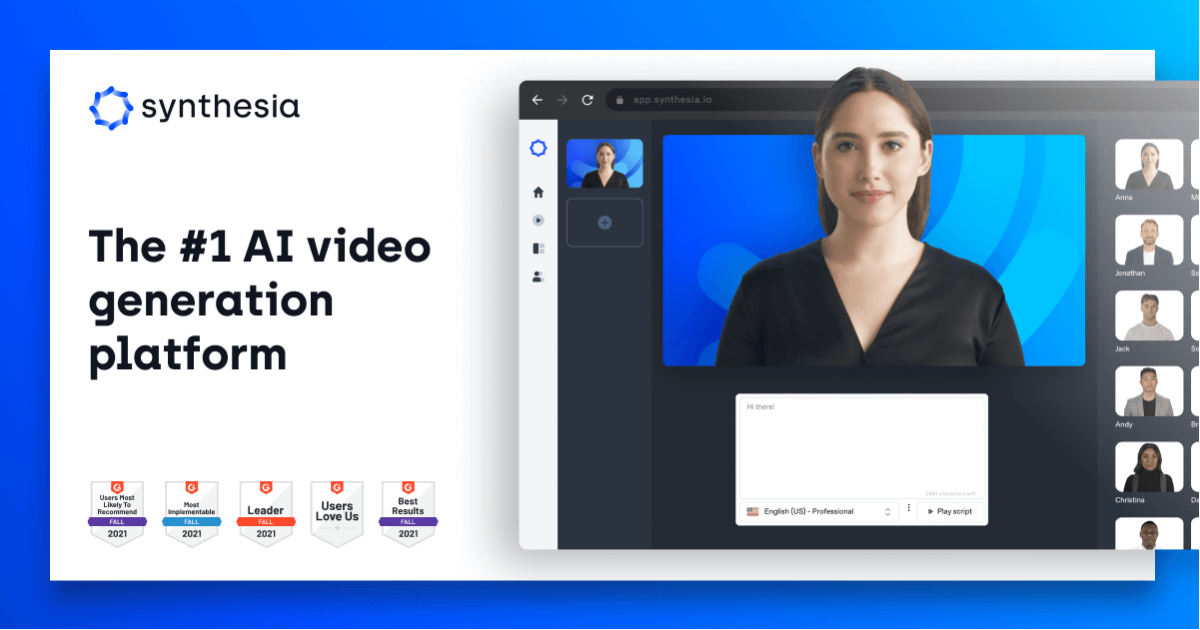
The platform uses digital twin technology to create realistic avatar presenters from text scripts. You write what you want to say, select an avatar, choose a language, and Synthesia generates a video of that avatar speaking your script with natural expressions and gestures. The avatars aren't cartoon characters or obviously synthetic. They're photorealistic digital humans that most viewers cannot distinguish from real video at first glance.
140 Languages and Counting
The multilingual capability transforms global training programs. A multinational corporation can create a training video once in English, then generate identical content in Spanish, Mandarin, Hindi, Arabic, French, German, and 133 other languages without recording anything additional. The avatar speaks each language with appropriate accents and natural pronunciation. This localization capability alone justifies the investment for companies with global workforces.
Enterprise Adoption Metrics
Synthesia leads the AI avatar category in both customer count and revenue among mid-market and enterprise companies. The company reached approximately 70 customers in tracking panels by early 2026 and generates the vast majority of observed spending in the category. Those aren't small pilot projects either. Average contract values are more than three times higher than competitor HeyGen, indicating larger deployments and deeper enterprise penetration.
The Learning and Development Use Case
HR and learning and development teams represent Synthesia's core market. Employee onboarding, compliance training, policy updates, product knowledge, and soft skills development all require regular video content. Traditional production costs made video training prohibitively expensive for many programs. Synthesia dropped those costs dramatically while simultaneously improving update speed and translation coverage.
Express-2 Full-Body Avatars
The recent introduction of Express-2 full-body avatars expanded beyond talking heads to include body language and gestures. Previous versions showed avatars from shoulders up in static poses. Express-2 avatars can gesture while speaking, stand and move naturally, and convey information through body language as well as speech. This added dimension makes training videos more engaging and allows demonstration of physical processes or procedures.
Custom Avatar Creation
Enterprise plans include custom avatar creation, allowing companies to create digital versions of their own executives or subject matter experts. The CEO can deliver company updates, the head of compliance can explain policy changes, and the product team can demonstrate new features, all through AI-generated videos that feel personal even though they're entirely synthetic. Custom avatars maintain brand consistency and build familiarity across training programs.
The Production Speed Advantage
Speed matters enormously for timely communications. When policies change, products update, or crises emerge, companies need to communicate quickly. Traditional video production cannot match the urgency. Synthesia users generate updated training videos in hours instead of weeks. For time-sensitive communications, this speed advantage can be strategically significant.
Video Agents Coming to Enterprise Plans
Upcoming Video Agents on Enterprise plans will automate video creation based on triggers and data sources. Imagine new hire paperwork automatically triggering personalized onboarding videos, sales data generating performance review content, or product updates creating training materials without human intervention. These automated workflows represent the next evolution beyond manual video creation.
Governance and Consent Protocols
Synthesia has taken a proactive stance on ethics by using paid actors for stock avatars and implementing strict governance around consent and usage rights. In an industry facing scrutiny around training data and deepfake concerns, this responsible approach builds enterprise trust. Corporate legal and compliance teams need assurance that the tools they deploy won't create liability or ethical issues.
The HeyGen Competition
HeyGen is growing faster in raw customer acquisition with 152% year-over-year growth compared to Synthesia's 30%. However, Synthesia maintains leadership in revenue due to those significantly higher contract values. The competitive dynamic shows classic enterprise versus SMB positioning. HeyGen captures smaller customers quickly while Synthesia focuses on larger enterprise deployments with deeper integration and higher spending.
Multi-Vendor Usage Patterns
Early data shows companies using both Synthesia and HeyGen for different purposes, unlike AI video generation tools where companies typically pick one platform. This pattern suggests the avatar video category might support multiple winners serving different segments rather than consolidating around a single dominant player.
Integration with Learning Management Systems
Enterprise customers integrate Synthesia with existing learning management systems like Cornerstone, SAP SuccessFactors, and Workday Learning. The API access allows automated video creation based on LMS data, embedding videos directly in training modules, and tracking completion metrics alongside other learning content. This integration makes Synthesia feel like a native capability rather than a separate tool.
The Measurement Challenge
Proving ROI on training videos remains difficult regardless of production method. Synthesia helps by dramatically reducing costs and production time, but the fundamental question of whether video training improves outcomes better than other methods persists. Companies adopting Synthesia typically justify the investment on cost savings and update speed rather than learning effectiveness claims.
Corporate Communications Beyond Training
While learning and development drives most usage, corporate communications teams use Synthesia for company updates, policy announcements, benefits explanations, and internal marketing. Any scenario requiring scalable video communications benefits from the avatar approach. The platform has expanded beyond its original training focus into broader enterprise video needs.
The Scaling Economics
Traditional video scales poorly. Producing 100 videos costs roughly 100 times more than producing one. Synthesia's economics work differently. Once you have an avatar and template, producing additional videos has minimal marginal cost. This economic advantage grows stronger as video volume increases, making Synthesia particularly valuable for organizations with extensive training libraries or frequent content updates.
The $200 million funding and rapid headcount growth signal confidence that AI avatar video will become standard infrastructure for enterprise communications and training. The question isn't whether companies will adopt this technology but how quickly Synthesia can capture that market before competitors mature. Based on current adoption rates and revenue metrics, Synthesia built a significant head start that will be difficult for others to overcome.
Transform your corporate training at Synthesia today.
The fact that they turned down a $3 billion Adobe acquisition offer tells you everything about where the founders think this is going. You do not walk away from that number unless you have very specific reasons to believe the company is worth multiples more.
The propaganda misuse issue from 2023 is worth revisiting. They said they improved detection and added moderation. That is not the same as the problem being solved. It is an ongoing arms race and anyone who tells you it is fully resolved is oversimplifying.
Does anyone actually track whether employees retain information better from AI avatar videos versus reading a PDF? Asking genuinely because our execs love the idea but nobody seems to have solid learning outcome data.
90% of Fortune 100 companies using this platform is wild when you stop to think about it. That means most large company employees have probably watched one of these videos without knowing it.
Fair point but the bottleneck moving still matters enormously. If the hard part shifts from production to scripting, you can now have subject matter experts doing the work instead of waiting for studio availability. That is a real efficiency gain even if it is not magic.
The LMS integrations are where this becomes sticky at enterprise scale. Once Synthesia is embedded inside Cornerstone or SuccessFactors workflows, switching costs become enormous. That is intentional and smart.
The deepfake concern is real and I do not think the article addresses it seriously enough. Yes, they use paid actors and have consent protocols. But the same technology that makes your compliance video also makes synthetic propaganda, and that actor whose face ended up in Venezuelan government disinformation campaigns probably did not sign up for that.
Four billion dollar company, UK based, founded in 2017. This is the kind of story that should be getting more attention as proof that European AI startups can compete at global scale.
Completed our third year with Synthesia and the biggest surprise is how it changed who makes videos. It used to be a small production team. Now department heads and team leads create their own content. Decentralizing video creation was not in the business case but it turned out to be the most valuable outcome.
Valuation doubled from $2.1 billion to $4 billion in a single year. That trajectory either ends in an IPO or the largest acqui-hire in enterprise SaaS history.
The Express-2 full body avatars are a genuine upgrade. The old talking head format always felt weirdly disembodied for anything involving physical procedures or demonstrations. Gestures matter more than people realize for instructional content.
The ROI measurement problem the article mentions at the end is genuinely the Achilles heel of enterprise training investment broadly, not just for AI video. Proving learning transfer is hard. Most L&D teams live and die by completion rate data instead.
The part about Video Agents triggering automatically from data sources is either the best product idea in enterprise training or a completely unreviewed content liability waiting to happen. Probably both.
The article calls the custom avatar feature deeply personal even though it is entirely synthetic. Those two things are in direct tension and the article just breezes past it.
The article says the question is not whether companies will adopt this technology but how quickly. That framing assumes the technology keeps improving and the ethics concerns do not catch up. I would not assume either of those things.
The Fortune 100 adoption numbers are impressive but also a little circular. Once enough big companies adopt something it becomes safer for other big companies to adopt it. Network effects in enterprise compliance culture are wild.
We use Synthesia for onboarding and HeyGen for sales enablement content. They actually serve different enough purposes that running both makes sense for us. The article kind of hints at this but undersells how common the dual vendor approach already is.
The article glosses over the fact that Starter plan limits will frustrate most serious users quickly. Ten video minutes per month sounds like a lot until you account for a typical compliance training refresh cycle. Enterprise pricing is where the real use case lives and that is a very different budget conversation.
The argument that this becomes standard enterprise infrastructure feels right to me. Video for internal communications used to be a luxury. The cost curve Synthesia created makes it accessible enough to become default.
Speaking as someone who trains learning and development professionals, the biggest cultural shift is not the tool. It is convincing subject matter experts that they can now be content creators. The technology is ready faster than the organizational change.
The fact that early customers are using both Synthesia and HeyGen for different purposes rather than picking one is actually a bullish signal for the whole category. It means the market is expanding rather than consolidating around a winner takes all dynamic.
I wonder how the average training video watcher feels about this. Nobody tells employees their onboarding was made by an AI avatar. Should they be told?
Used this for a product launch training rollout across 15 countries last quarter. The localization time savings alone paid for two years of the subscription. That is not marketing copy, that is just the math.
Does the 140 language support include genuine regional accent variation, or is it just the same neutral voice translated into different languages? That distinction matters enormously for authenticity in regional markets.
Interesting that the article does not mention Colossyan, which is also competing hard in the enterprise training video space. The market is bigger than a two horse race.
What nobody is talking about is the environmental footprint of GPU-intensive video rendering at scale. When you are generating training content for 60,000 enterprise customers the compute costs are real, and so is the energy consumption. Would be curious to see those numbers.
The article makes the ROI case almost entirely on cost reduction. That is the right argument for procurement but it is the wrong framing for learning strategy. We should be asking whether people are actually better at their jobs afterward.
The consumer deepfake worry feels different from the enterprise use case. A corporate training platform with SOC 2 compliance, audit trails, and consent frameworks is not the same risk surface as a consumer app. People conflate them constantly.
Video Agents that auto-generate content based on triggers and data sources sounds incredible on paper. New hire paperwork triggering a personalized onboarding video is genuinely useful. The part that makes me nervous is who audits the output before it reaches the employee.
The framing of this as Synthesia essentially having no competition is a stretch. HeyGen is growing three times faster by customer count and the quality gap has narrowed considerably. Calling this a head start that will be difficult to overcome feels like investor relations language.
The headline says your training videos write themselves. They absolutely do not write themselves. You still need someone to write the script, check for accuracy, review the output, and maintain the content library. The production bottleneck moved, it did not disappear.
HeyGen growing at 152% year over year is not a footnote. That is a threat. Revenue advantage can evaporate if the challenger keeps acquiring customers at that rate and then monetizes them.
This is fundamentally a story about what happens when you pick a boring unsexy enterprise use case and execute on it for eight years while everyone else chases the consumer market. Corporate training is not glamorous. The financials very much are.
Working in instructional design and the shift in how L&D budgets get allocated because of tools like this is real. Money that used to go to production vendors is now going to content strategy and scripting. Which honestly is where it should have been all along.
As a compliance officer the governance piece is genuinely important to me. The fact that they proactively built consent and usage rights frameworks rather than waiting for regulation tells me something about how seriously leadership takes this.
Not sure why the article keeps saying 140 languages when Synthesia now advertises 160 plus. Minor point but details matter in a post about a $200M raise.
The fact that the UK government cited this as a national success story matters for the regulatory environment Synthesia operates in. Political capital at that level creates headroom that pure compliance cannot.
Being used by 70% of FTSE 100 companies and 90% of Fortune 100 is a moat in the form of institutional inertia as much as anything technical. Switching costs compound with every integrated workflow and every content library built on the platform.
As someone who manages L&D for a company with offices across 11 countries, the multilingual piece is not a nice to have. It is the entire reason we signed an enterprise contract. Recreating compliance training in Mandarin, Portuguese, and Hindi used to take months per cycle. We did our last refresh in under two weeks.
The article frames this as Synthesia essentially creating a new category. That is fair. But being the category creator does not guarantee you win the category long term. Ask the first social video platforms about that.
Spent way too long trying to get medical content approved through their moderation system. Even basic healthcare compliance material kept hitting blocks. The governance is thorough to a fault if you are in a regulated industry.
Good question, actually. Their AI dubbing supports around 30 languages with proper lip sync, and the full text to speech library covers 140 plus. So the experience quality does vary depending on which tier of language support you are using.
Hot take, the real disruption here is not the AI avatars. It is the economics. When producing video number 100 costs roughly the same as producing video number one, the entire calculus of corporate training changes overnight.
For teams outside English speaking markets this technology is not incremental, it is transformative. Our regional offices in Southeast Asia had basically zero localized training content before this because the cost was prohibitive. That has completely changed.
Speaking from experience running a global HR team, the update speed is what sells this internally. When a regulation changes and you need to push updated training to 4,000 employees across six time zones by end of week, nobody is booking a studio.
Bold prediction. Within three years someone is going to use a custom executive avatar to commit fraud and it will become a major regulatory case that reshapes consent law around synthetic media.
We piloted this for new hire onboarding six months ago. The feedback from new employees was surprisingly warm. Most of them said it felt more personal than a slide deck with narration, which honestly set a low bar, but still.
From an instructional design perspective the full body avatars matter more than they seem. Body language carries a huge amount of meaning in instructional content. A talking head delivering safety procedure training is genuinely worse than a demonstrating full body avatar.
The $100M ARR milestone hit in April 2025 and they are projecting past $200M for 2026. That kind of trajectory is what Series E rounds at $4B valuations are made of. The math is not irrational.
Photorealistic avatars that most viewers cannot distinguish from real video at first glance. That sentence deserves more scrutiny than this post gives it.
From an IT procurement perspective the real hidden cost is not the license fee. It is the internal time to integrate APIs, configure LMS connectors, and maintain content at scale. Nobody budgets for that accurately.
Honestly the uncanny valley problem has mostly been solved for internal corporate use. Nobody expects a training video presenter to have the warmth of a live teacher. The standard is just professional and clear.
As a former studio video producer who retrained into L&D, watching this play out has been surreal. The workflow I spent years mastering is now software. The scripting and instructional design skills I always treated as secondary turned out to be the durable ones.
The scaling economics argument is the strongest part of this entire post. Traditional video really does scale linearly with cost. Synthesia breaks that entirely. That is a fundamentally different business case than just faster production.
Still waiting for someone to run a rigorous study on completion rates and knowledge retention for AI avatar training versus traditional instructor led sessions. We keep adopting these tools on vibes and cost spreadsheets.
My skepticism is on the learning effectiveness side. The article even admits companies justify adoption on cost savings and speed, not on whether people actually learn better. That gap matters if you care about training outcomes and not just training budgets.
Google Ventures leading this round after already being in from Series B is the detail I keep coming back to. That is not a new investor doing discovery diligence. That is an existing investor with full visibility into the numbers choosing to double down.
Genuinely excited about the Video Agents feature for onboarding specifically. The idea that a new hire completing paperwork could automatically trigger a personalized day one video from their manager's avatar is either incredibly thoughtful or deeply impersonal, and the line between those two things is thinner than it should be.
As someone who reviewed vendor options for an L&D tech stack refresh last year, the SOC 2 Type II compliance is not optional for enterprise procurement. A lot of competing tools in this space cannot clear that bar. That alone narrows the field significantly.
Enterprise software pricing transparency remains the industry's darkest art. The article mentions contract values are three times higher than HeyGen without mentioning actual numbers. Annual contracts with custom per seat pricing that the sales team quotes you is not exactly a trust builder.
Valuation nearly doubled in one year from Series D to Series E. Either the business grew that fast, or late stage AI multiples are doing a lot of heavy lifting in that number. Probably both.
The pricing structure is sneakier than the article implies. Starter plan gives you 10 video minutes per month, which sounds fine until you realize one training module eats half that. You hit enterprise pricing faster than you expect.
The consent framework for custom avatars is going to get tested hard when executives leave companies under difficult circumstances. What happens to a CEO custom avatar after a forced resignation? These are not hypotheticals, they are contracts waiting to be litigated.
Genuinely curious whether the video agent automation feature will require human review in regulated industries like finance or pharma, or whether it is fully automated output. That distinction will determine adoption in exactly the sectors Synthesia wants most.
There is something quietly significant about the Nasdaq secondary sale structure for employees. Staying private longer while still giving employees liquidity is a model that more growth stage companies will probably follow.
The point about needing to communicate quickly when policies change or crises emerge is undersold. We had a data security incident last year and needed to push updated training to 8,000 employees within 48 hours. There is simply no traditional production process that moves that fast.
152% year over year customer growth for HeyGen versus 30% for Synthesia. Framing slower growth as enterprise stability only works until the challenger catches up on revenue too.
As someone who has shot real corporate training videos for years, the time savings are genuinely real. A single day of studio time with a presenter, crew, and editing used to cost what Synthesia charges annually at entry level.
That is actually a growing conversation in the ethics space around synthetic media disclosure. Some companies are starting to add disclosures, others are treating it the same as any produced video content. No consensus yet and no regulation requiring it.
The custom executive avatar feature is going to create some genuinely uncomfortable situations. Imagine your CEO avatar delivering a message that the real CEO never actually approved in those exact words.
Adobe reportedly offered $3 billion to acquire them and Synthesia said no. At a $4 billion valuation now, that looks like a very smart decision in hindsight.
Hot take, in five years we will think of AI avatar video the way we think of email newsletters. Ubiquitous, often poorly used, occasionally powerful, and completely unremarkable as a technology.
What I want to know is how well the avatars handle technical jargon in non-English languages. Translating a software compliance training into Korean is one thing. Getting the pronunciation of specific technical terms right across specialized industries is a very different challenge.
My concern is vendor concentration. When 90% of Fortune 100 companies depend on one platform for a core training and communications workflow, the failure scenarios get interesting. What happens to your compliance training program if Synthesia has an outage during a regulatory deadline?
There's a version of this where AI avatar training videos become so ubiquitous and indistinguishable that employees stop trusting any video communication as authentic. That trust erosion risk feels underrated.
The post mentions integration with SAP SuccessFactors and Workday Learning. The API quality on those integrations is where the rubber meets the road. Surface level connectors are common. Deep native integrations that actually hold up at scale are rare.
Anyone know if the Video Agents feature works with Workday Learning specifically? That would be the integration that actually moves the needle for large enterprise HR teams.
The comparison between HeyGen and Synthesia misses a key point. They are genuinely not competing for the same buyer. HeyGen wins for marketing and social content, Synthesia wins for structured enterprise workflows and compliance environments. Using both makes total sense.
I appreciate that they use paid actors for stock avatars rather than scraped training data. That is not just an ethics checkbox. It is what makes enterprise legal teams comfortable signing the contract.