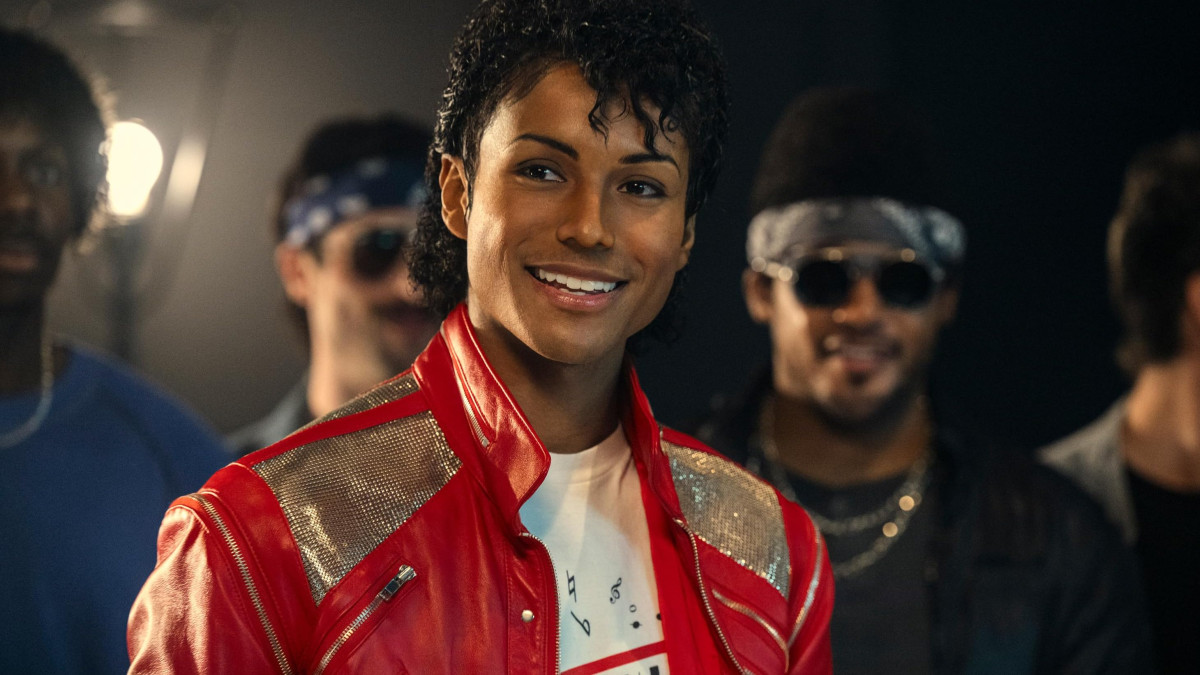

Jaafar vs any outside actor for this role is not even a close comparison when you think about what playing Michael Jackson actually requires. The physicality, the voice pattern, the family archive access. An outsider starts at zero on all of that.
Sign up to see more
SignupAlready a member?
LoginBy continuing, you agree to Sociomix's Terms of Service, Privacy Policy
Sign up to see more
SignupAlready a member?
LoginBy continuing, you agree to Sociomix's Terms of Service, Privacy Policy

Jaafar vs any outside actor for this role is not even a close comparison when you think about what playing Michael Jackson actually requires. The physicality, the voice pattern, the family archive access. An outsider starts at zero on all of that.
The Michael movie review verdict is in, and it is more complicated than the 26% Rotten Tomatoes score suggests. Antoine Fuqua's long-delayed Michael Jackson biopic, simply titled Michael, hit theaters this weekend with Jaafar Jackson playing his late uncle, and the critical response has been brutal. The BBC gave it one star. Roger Ebert's site called it a filmed playlist in search of a story. Yet early audience reactions on social media have been warmer, ticket pre-sales suggest an $80 million opening, and Variety thought it worked as an engrossing middle-of-the-road biopic. After tracking coverage across more than a dozen outlets over the past 48 hours, I think the honest answer to "should you watch this?" depends almost entirely on what you want from a music biopic, and this guide breaks down exactly what the film delivers, what it skips, and who will actually enjoy sitting through its two-hour-and-nine-minute runtime.
The creators behind some of Webtoon's most successful psychological thrillers have returned with a series that's already generating intense discussion across manhwa communities. For fans who've been following the horror and thriller genre on digital platforms, Carnby Kim and Youngchan Hwang need no introduction. Their latest collaboration tackles themes of artistic plagiarism, obsession, and murder in ways that feel disturbingly relevant to current conversations about creative theft and AI-generated content. This guide covers everything you need to know about Copycat, from its premise and release schedule to how it compares with their previous masterpieces like Sweet Home and Bastard.
The technology sector is experiencing a paradox. While headlines scream about mass layoffs at major tech companies, a critical shortage is quietly building in one of the most essential areas of digital infrastructure. Datacenters, the physical backbone of our digital world, are facing an unprecedented demand surge, and there simply are not enough skilled professionals to build and maintain them. Countries across the globe are rushing to establish their own datacenter infrastructure. From India's ambitious plans to become a datacenter hub to the European Union's push for data sovereignty, and emerging markets in Southeast Asia and Latin America building their first large scale facilities, the construction boom is just beginning.
The genre has surged so much that publishers are clearly greenlighting anything with a regression premise right now. The signal-to-noise ratio has gotten rough for new readers trying to find quality entries.
The comparison to Nano Machine keeps coming up in these discussions and it makes sense because Nano Machine basically proved that murim plus technology can work as a concept. This series is building on that foundation with much higher narrative ambition.
Worried this democratization narrative overlooks what it does to professionals. When the tool removes the skill barrier, it also removes the justification for rates that used to compensate for years of learned expertise.
Cascade is legitimately impressive for multi-file refactors. Gave it a large module migration last week and it handled import resolution and interface updates across eleven files without losing context.
The article makes the ROI case almost entirely on cost reduction. That is the right argument for procurement but it is the wrong framing for learning strategy. We should be asking whether people are actually better at their jobs afterward.
While Synthesia leads in revenue, HeyGen leads in customer acquisition momentum with 152% year-over-year growth in mid-market adoption. That explosive growth rate allowed HeyGen to close much of the customer count gap by late 2025. The company is winning by making avatar video accessible to smaller teams and individual creators who cannot afford enterprise contracts but need professional video capabilities. HeyGen positioned itself for small and medium businesses, marketing teams, content creators, and solo entrepreneurs rather than enterprise learning and development departments. This market segment values affordability, ease of use, and creative flexibility over governance features and advanced integrations. Average contract values are roughly one-third of Synthesia's, reflecting this different customer profile.
Genuinely cannot tell if this is the most important corporate rivalry of our lifetimes or the most expensive public argument in history. Possibly both at the same time.
The article talks about the education roots but glosses over how significant that legacy is. Tens of millions of people who learned coding on Replit now have a tool that amplifies what they learned. That installed base is a massive distribution advantage.
That co-design middle path is probably the smartest option. You get meaningful customization without the full organizational overhead and capital exposure of a completely in-house program. It is what Amazon effectively did with its early Trainium chips.
The article frames this as TikTok breaking from industry norms, but given that Meta just reversed Instagram E2EE around the same time, maybe the industry norm is shifting back toward access. The era of unconditional privacy promises on social media might genuinely be ending.
Every single person who said this feature would never come to Instagram because Meta does not care about user experience owes a small apology to no one in particular. It came. Just took forever.
The global cryptocurrency market capitalization has climbed back above the $2.5 trillion threshold, fueled by a massive liquidation of short positions and renewed institutional interest. Geopolitical developments and shifting investor sentiment combined to create a powerful rally that caught bearish traders off guard, resulting in substantial losses for those betting against the market. According to data from CoinGecko, the total market capitalization of all cryptocurrencies combined increased 1.4% to reach $2.52 trillion on Friday, April 10. Bitcoin experienced a notable surge of over 3%, briefly touching the $73,000 mark before consolidating around $72,000 at the time of writing. Ethereum demonstrated equally impressive strength, pushing past the $2,200 level, while the majority of top 10 cryptocurrencies by market capitalization also posted significant gains.
She and Anne Hathaway in the front row together is honestly a fun image. Two people who understand the power of a considered outfit.
Anyone know where I can find a more affordable version of that red top? The original is way out of my budget
Join independent creators, thought leaders, and storytellers to share your unique perspectives, and spark meaningful conversations.