
read the whole thing in like two days and genuinely didn't know what to do with myself after. felt weirdly hollowed out in the best possible way.
20
Sign up to see more
SignupAlready a member?
LoginBy continuing, you agree to Sociomix's Terms of Service, Privacy Policy

read the whole thing in like two days and genuinely didn't know what to do with myself after. felt weirdly hollowed out in the best possible way.
The series hits differently if you think of it as a story about inherited trauma. Bigang carries memories of centuries of horror that nobody else can share or even understand.
The article focuses a lot on isolation and mortality but barely touches on the political dimension. The crumbling empire is not just backdrop, it is context for why the Emperor's message still carries stakes.
It clicks around chapters 15 to 20 when the relic personalities start becoming a real storytelling element rather than just flavor text. First ten chapters are setup and worth pushing through.
In a manhwa landscape dominated by dungeon crawling, regression narratives, and power fantasies, The Greatest Estate Developer stands out by asking a simple question: what if the protagonist's greatest weapon wasn't a sword or magic system, but civil engineering knowledge? This bizarre premise transforms into one of the most entertaining, genuinely funny, and surprisingly heartfelt series currently running, proving that innovation in storytelling comes from unexpected places. The series takes the familiar isekai setup where a modern person finds themselves in a fantasy world and completely subverts expectations. Instead of becoming an adventurer or hero, protagonist Kim Suho uses his engineering knowledge to revolutionize construction, infrastructure, and economic development. What sounds like it should be boring becomes absolutely captivating through sharp writing, excellent comedic timing, and genuine passion for showing how infrastructure improves lives.

What gets lost in the speed conversation is testability. AI-generated code often lacks unit tests, edge case handling, and error states that a thoughtful developer would include. Those gaps bite you later.
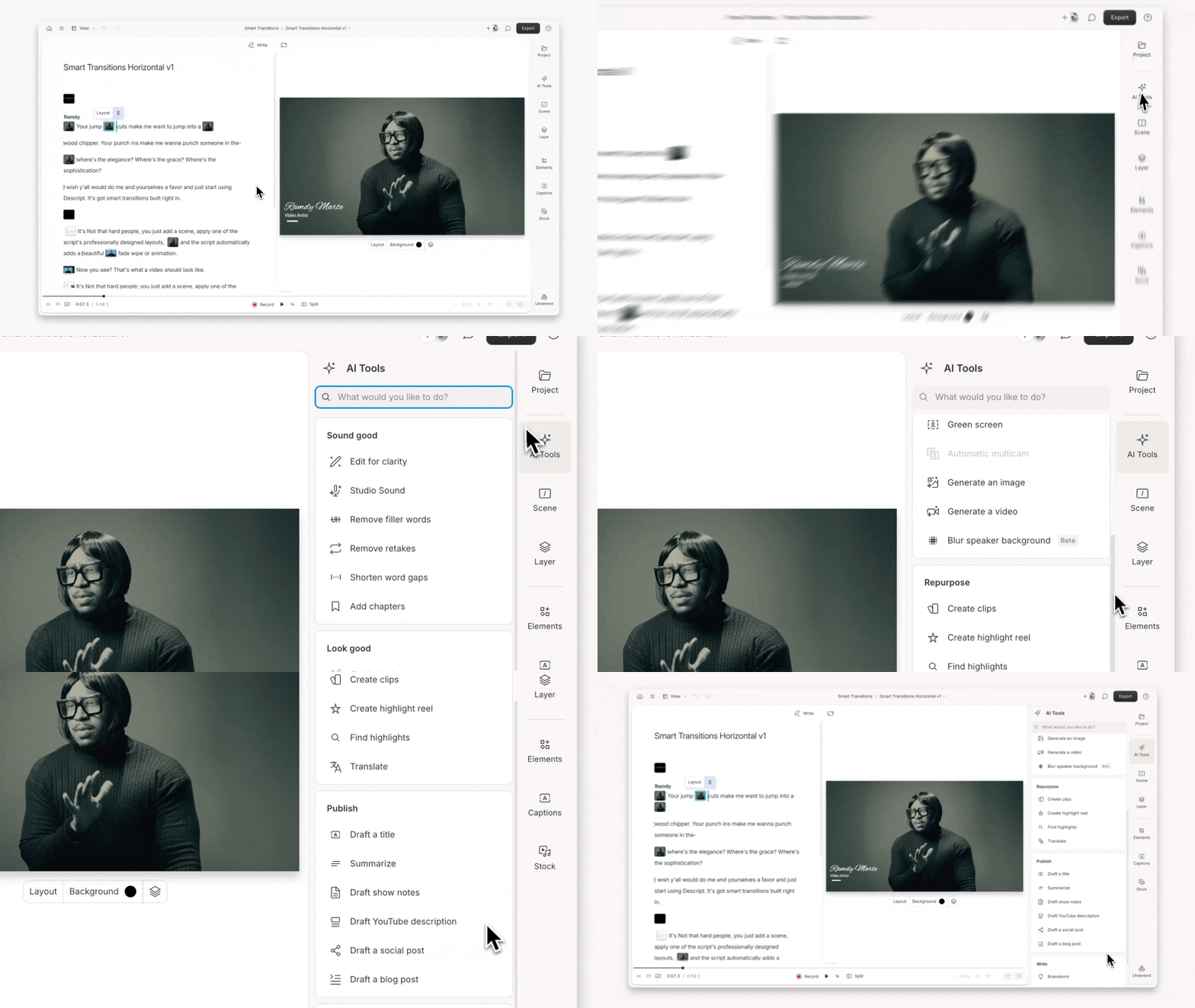
Most people can edit a Google Doc. Delete some words, rearrange sentences, fix typos, add paragraphs. It's intuitive and requires no special training. Now imagine editing video the same way. That's Descript's core innovation, and it transformed video editing from a specialized skill requiring expensive software into something anyone who can edit text can do effectively. Descript started as a transcription tool for podcasters. Record your podcast, upload it to Descript, and get an accurate transcript for show notes. But the founders realized something bigger. If you have a perfect transcript synchronized to audio, you can edit the audio by editing the text. Delete a word from the transcript and that word disappears from the audio. That insight became the foundation for a complete editing platform.
Forty million dollars in annual recurring revenue. Six months. One browser-based platform. Those numbers would be impressive for any software company, but for Bolt.new, they represent something more significant: the moment when development environments moved permanently into the cloud and never looked back. Traditional software development has always required setup. Install Node.js, configure your environment, manage dependencies, set up local servers, troubleshoot version conflicts. Before writing a single line of code, developers spend hours or even days preparing their machines. Junior developers often spend their first week just getting their environment working. Bolt.new eliminated all of that with WebContainers technology.
At the end of the day this technology just makes the cost of a professional-looking video tend toward zero over time. That is a force of nature at this point and arguing about whether it is good or bad is less useful than figuring out how to position around it.
As someone who has watched Meta's AI efforts for years, this feels different. Llama was always a research play dressed up as a product. Muse Spark is the opposite. It is a product play backed by serious research. That is a meaningful change in orientation.
As someone who works in child safeguarding, this debate is not as clean as privacy advocates want it to be. We have genuinely intercepted grooming conversations through platform scanning. The technology saves kids. That is just a fact even if it makes privacy purists uncomfortable.
As someone who manages a mid-size engineering team, the question we keep asking is not which tool is better today but which company is going to iterate faster over the next two years. That answer is not obvious.
Competition is making both products better faster than either would improve alone. That is the actual headline here.
Anthropic on Tuesday unveiled an advanced artificial intelligence model designed specifically to identify software vulnerabilities, marking a significant development in the intersection of AI and cybersecurity. The model, named Claude Mythos Preview, will be available exclusively to a carefully selected group of companies as part of Project Glasswing, a new security initiative that aims to strengthen digital defenses while preventing malicious exploitation. The San Francisco based AI company has chosen to severely restrict access to Claude Mythos Preview due to its powerful capability to detect security weaknesses and software flaws. This decision reflects growing concerns about dual use AI technologies that could be weaponized by adversaries if they fell into the wrong hands.

Actually, I think the bow adds a perfect feminine touch without being overwhelming
Has anyone tried the overalls in different colors? I'm thinking about getting them in navy