
The article is a little too cheerful about how easy the transition is. The physical and operational realities are genuinely demanding. But the opportunity is absolutely real if you go in with clear eyes.
17
Sign up to see more
SignupAlready a member?
LoginBy continuing, you agree to Sociomix's Terms of Service, Privacy Policy

The article is a little too cheerful about how easy the transition is. The physical and operational realities are genuinely demanding. But the opportunity is absolutely real if you go in with clear eyes.
The Regressor arc is where the series gets genuinely philosophically dense. Two people who both know futures that conflict with each other trying to work together without revealing what they know is one of the most layered things the series does.
In a manhwa landscape dominated by dungeon crawling, regression narratives, and power fantasies, The Greatest Estate Developer stands out by asking a simple question: what if the protagonist's greatest weapon wasn't a sword or magic system, but civil engineering knowledge? This bizarre premise transforms into one of the most entertaining, genuinely funny, and surprisingly heartfelt series currently running, proving that innovation in storytelling comes from unexpected places. The series takes the familiar isekai setup where a modern person finds themselves in a fantasy world and completely subverts expectations. Instead of becoming an adventurer or hero, protagonist Kim Suho uses his engineering knowledge to revolutionize construction, infrastructure, and economic development. What sounds like it should be boring becomes absolutely captivating through sharp writing, excellent comedic timing, and genuine passion for showing how infrastructure improves lives.

Does anyone else find it interesting that the web novel actually finished in July 2025 but the manhwa is still ongoing? So technically we already know how the full story ends, we're just waiting on the visual adaptation to catch up.
does anyone else reread specific arcs just to see if you missed anything or is that just a me thing
SSS-Class Revival Hunter should absolutely have been on this list. A protagonist who gains powers by dying repeatedly is one of the most creative mechanics the genre has ever produced.
Second Life Ranker gets unfairly dismissed by readers who gave up in the middle chapters. The series goes through some pacing issues around the midpoint but the later arcs are some of the most ambitious storytelling in the entire genre.
The found family dynamic that develops across arcs is something the article gestures at but does not fully explore. That element carries a lot of the emotional weight in the later half of the story.
Genuinely curious, does Dungeon Reset stay good for the full run or does it fall off? Every long-running manhwa seems to hit a wall eventually.
I wonder how the average training video watcher feels about this. Nobody tells employees their onboarding was made by an AI avatar. Should they be told?
This is all cool but I tried Runway twice and gave up both times because the credit system is confusing and the UI feels designed for people who already know what they are doing. Barrier to entry for new users is real.
The comparison between paying $50,000 for a three-month agency project versus a monthly subscription is a bit misleading. Agency work includes requirements gathering, testing, QA, ongoing support, and accountability. You are not comparing apples to apples.
Forty million dollars in annual recurring revenue. Six months. One browser-based platform. Those numbers would be impressive for any software company, but for Bolt.new, they represent something more significant: the moment when development environments moved permanently into the cloud and never looked back. Traditional software development has always required setup. Install Node.js, configure your environment, manage dependencies, set up local servers, troubleshoot version conflicts. Before writing a single line of code, developers spend hours or even days preparing their machines. Junior developers often spend their first week just getting their environment working. Bolt.new eliminated all of that with WebContainers technology.
The manhwa world exploded when Solo Leveling first introduced us to Sung Jinwoo's journey from the weakest hunter to humanity's strongest defender. Now, Solo Leveling Ragnarok brings a fresh perspective to this beloved universe, and fans everywhere are asking the same questions. Can the sequel live up to the original? Do you need to read Solo Leveling first? What makes this continuation worth your time? This guide covers everything you need to know about Solo Leveling Ragnarok, whether you're a longtime fan or someone curious about jumping into the series Solo Leveling Ragnarok is not a reboot or alternate timeline. This is a direct sequel that continues the story years after the original series concluded. The protagonist shifts from Sung Jinwoo to his son, Sung Suho, who must forge his own path in a world still recovering from the catastrophic events his father prevented.

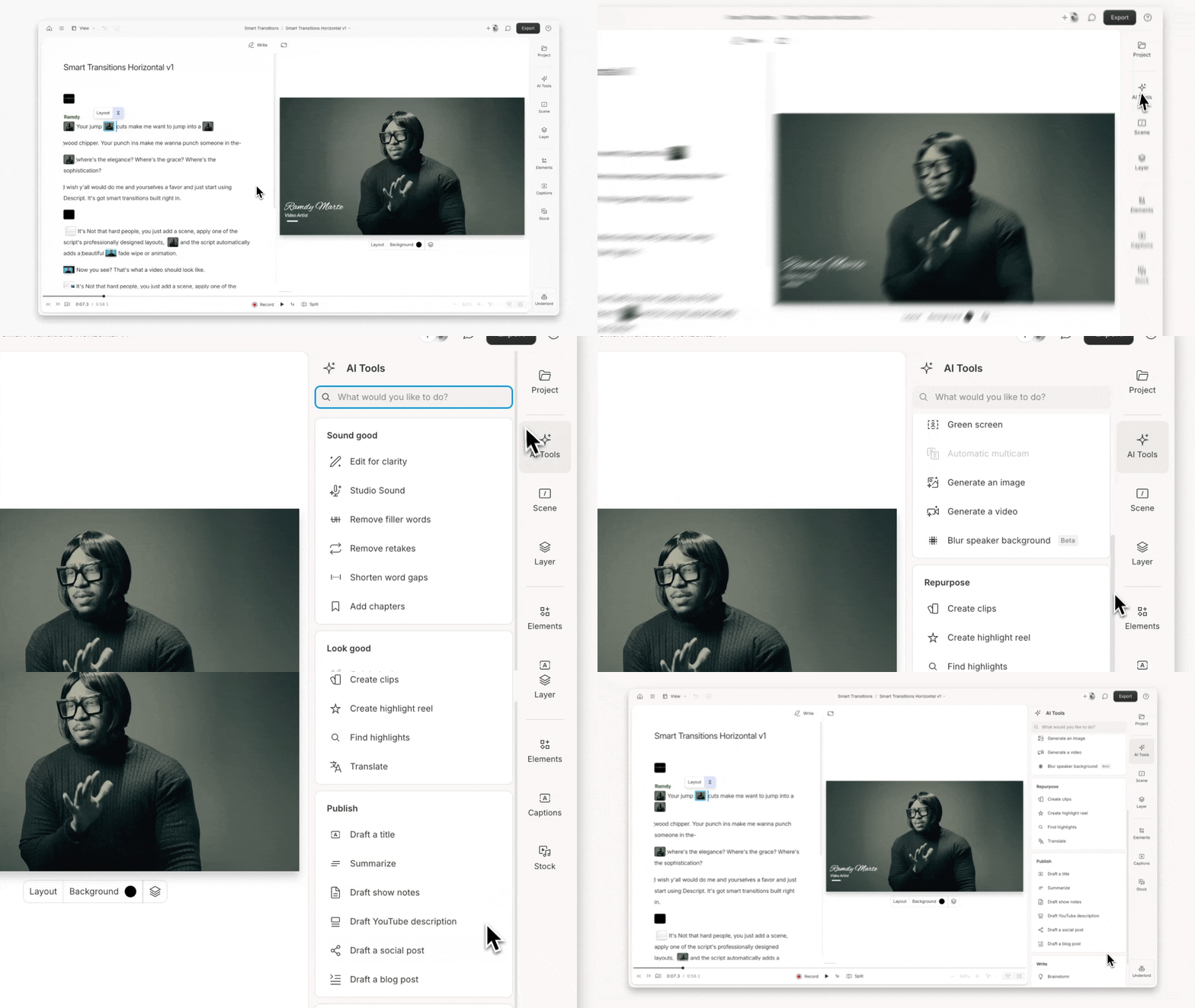
Most people can edit a Google Doc. Delete some words, rearrange sentences, fix typos, add paragraphs. It's intuitive and requires no special training. Now imagine editing video the same way. That's Descript's core innovation, and it transformed video editing from a specialized skill requiring expensive software into something anyone who can edit text can do effectively. Descript started as a transcription tool for podcasters. Record your podcast, upload it to Descript, and get an accurate transcript for show notes. But the founders realized something bigger. If you have a perfect transcript synchronized to audio, you can edit the audio by editing the text. Delete a word from the transcript and that word disappears from the audio. That insight became the foundation for a complete editing platform.
As a parent, the 13 plus content rating change for teen accounts means more to me than editable comments ever will. My kid has been on this platform since they were barely old enough and the algorithm has shown some genuinely alarming stuff. So yes, the policy changes matter.
That is actually a fascinating point. If keywords in comments now affect discoverability, then the edit window essentially becomes a brief optimization opportunity. Social media managers are definitely going to start treating those 15 minutes strategically.
Genuinely curious what the disclosure timeline looks like for the thousands of vulnerabilities that have not been patched yet. 135 days is the number mentioned but coordinating that across every major OS and browser simultaneously is a logistical nightmare.
Honestly I am more interested in how CrowdStrike integrates this into actual products. They have the endpoint visibility and adversary tracking. If Mythos-level capabilities get built into commercial security tools the market shifts dramatically.
In an extraordinary move signaling growing alarm over artificial intelligence capabilities, US Treasury Secretary Scott Bessent and Federal Reserve Chair Jerome Powell jointly summoned the nation's most powerful banking executives to an emergency meeting this week at Treasury headquarters in Washington, DC. The hastily arranged gathering centered on mounting cybersecurity concerns stemming from Anthropic's latest artificial intelligence system, known as Claude Mythos. The San Francisco-based AI company recently disclosed that its newest model demonstrates unprecedented abilities to identify and exploit software vulnerabilities, raising immediate red flags across the financial sector and national security establishment.