
God of High School's later arcs went off the rails visually though. Power scaling became so abstract the fights stopped being readable. Nano Machine maintains clarity even as the scale grows, which is exactly what GodHS lost.
19
Sign up to see more
SignupAlready a member?
LoginBy continuing, you agree to Sociomix's Terms of Service, Privacy Policy

God of High School's later arcs went off the rails visually though. Power scaling became so abstract the fights stopped being readable. Nano Machine maintains clarity even as the scale grows, which is exactly what GodHS lost.
In a manhwa landscape dominated by dungeon crawling, regression narratives, and power fantasies, The Greatest Estate Developer stands out by asking a simple question: what if the protagonist's greatest weapon wasn't a sword or magic system, but civil engineering knowledge? This bizarre premise transforms into one of the most entertaining, genuinely funny, and surprisingly heartfelt series currently running, proving that innovation in storytelling comes from unexpected places. The series takes the familiar isekai setup where a modern person finds themselves in a fantasy world and completely subverts expectations. Instead of becoming an adventurer or hero, protagonist Kim Suho uses his engineering knowledge to revolutionize construction, infrastructure, and economic development. What sounds like it should be boring becomes absolutely captivating through sharp writing, excellent comedic timing, and genuine passion for showing how infrastructure improves lives.

The regression premise is so common in manhwa now that Returner's Magic and Tomb Raider King being on the same list is almost funny. How many protagonists got sent back in time with future knowledge this year.
JH's ability to make you care deeply about a character in the span of a single chapter and then put them in an impossible situation is almost cruel. It borders on emotionally manipulative in the best possible way.
The article describing Season of Blossom as relatively untested territory for romance manhwa anime is interesting because True Beauty Season 2 is also coming this year and it seems like the obvious precedent.
The article makes the ROI case almost entirely on cost reduction. That is the right argument for procurement but it is the wrong framing for learning strategy. We should be asking whether people are actually better at their jobs afterward.
The trust problem is real. Recent developer surveys show that while AI tool adoption keeps climbing, trust in the actual output has dropped pretty sharply. Using these tools more does not mean trusting them more.
Speaking from experience building products on top of these APIs, the reliability and uptime differences between Claude and GPT-4 class models matter enormously for production systems. Anthropic's infrastructure reliability improved dramatically in late 2025 and that's part of why enterprise adoption accelerated.
As someone learning to code, I have mixed feelings. Using the agent to build things is exciting but I worry about skipping the understanding phase. The best developers I know have deep mental models of how systems work. You do not build that by watching AI write code.
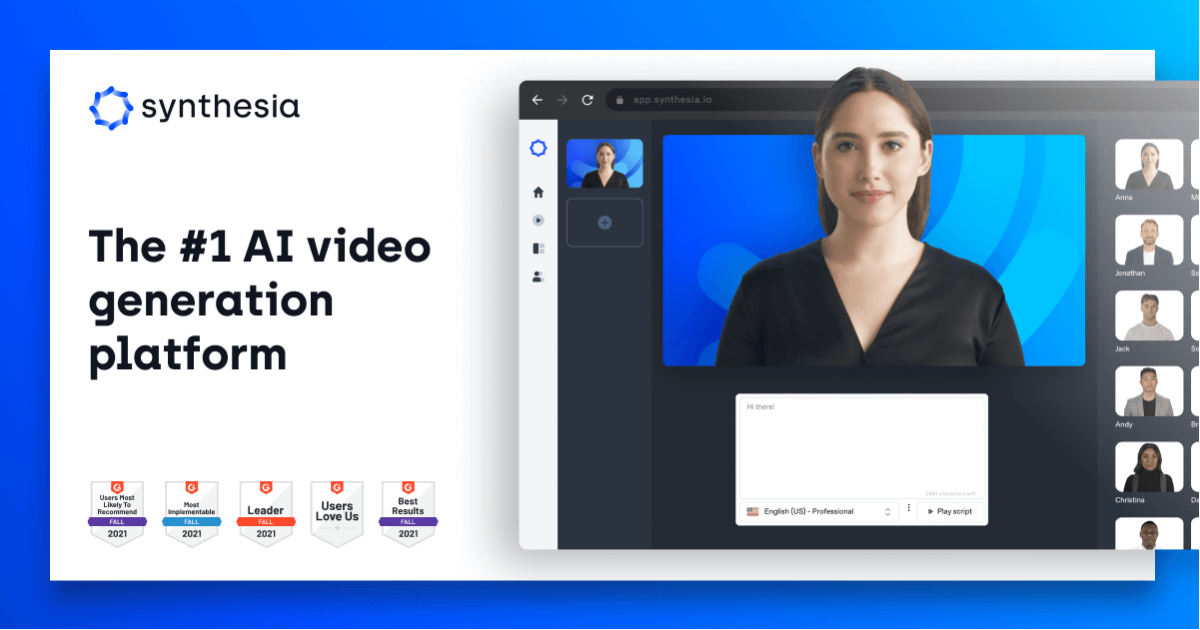
When a company raises $200 million in Series E funding during January 2026, investors are betting on more than potential. They're backing proven market demand and sustainable growth. Synthesia's funding round came alongside a 44% year-over-year increase in headcount to 706 employees, signaling aggressive expansion in a category the company essentially created: AI avatar-based video generation for enterprise training and communications. Corporate training videos have been expensive and slow to produce for decades. Recording a single 10-minute training module traditionally required booking a studio, hiring a presenter, scheduling a videographer, managing multiple takes, and editing everything together. If you needed to update information or translate content, you essentially started over. Synthesia eliminated this entire production workflow by replacing human presenters with AI avatars.
The artificial intelligence industry is entering a new phase of competition, one that extends far beyond the development of advanced language models and neural networks. Companies are now engaged in an intense struggle to secure the computational infrastructure necessary to train and deploy their AI systems. In this context, Anthropic has reportedly begun exploring the possibility of designing and manufacturing its own specialized processors to power Claude, its flagship conversational AI platform, along with its broader suite of artificial intelligence technologies. This strategic consideration emerges at a critical moment in the global AI sector. The exponential growth in model complexity and capability has created unprecedented demand for high-performance computing resources. Sources familiar with the matter indicate that Anthropic is conducting feasibility studies to determine whether developing proprietary semiconductor technology could reduce its dependence on external hardware vendors while ensuring reliable access to the computing power required for its operations.
OpenAI's latest subscription offering represents its most aggressive move yet to reclaim market share in the rapidly expanding AI-powered coding assistant sector
DCA and stop worrying about the daily candles. That's my whole strategy and honestly it's the only one that has ever worked consistently for me.
Not gonna lie, every time a tech company says trust us with your private data we have strict internal controls, within about 18 months there is a report about employees abusing those controls or a breach exposing them. This pattern is so consistent it should be part of the risk calculation.
The article's point about semiconductor development operating on three to five year timelines is the key constraint that I do not think gets enough emphasis. This is not like shipping a software update. You commit resources today for outcomes that land in a completely different competitive environment.
Meta has just had one of its most important AI moments yet and the early signals are hard to ignore. Following the launch of its newest AI model Muse Spark, the company’s standalone Meta AI app surged dramatically in popularity, hinting at a much larger shift that is beginning to take shape. The release is particularly significant because it marks the first major AI model rollout under Alexandr Wang, who joined Meta to reboot its AI strategy. This is not just another incremental update. It represents a more aggressive and focused push into the AI race. According to data from Appfigures, Meta AI jumped from number 57 to number 5 on the U.S. App Store within a day of the launch. That kind of movement rarely happens without a strong underlying pull from users. It signals not curiosity but intent.
My concern is less with Mythos specifically and more with what comes after Mythos when the next generation of models makes this one look like a calculator.
When you hear “Paris Fashion Week,” your mind races to haute couture, bold statements, and the world’s most glamorous attendees. But on October 4, 2025, the scene got a surprise guest—Meghan Markle, making what might be her most talked-about entrance yet. To call it a “debut” feels almost too neat, as if she’s stepping into a world she’s never touched. Yet, Meghan’s gradual evolution as a style influencer has been anything but accidental. Her Paris moment isn’t just celebrity spectacle; it’s a statement, a pivot, and a nuanced step into a new chapter. Here’s my take on why this matters.

Trust me ladies, invest in good nude heels. They go with absolutely everything