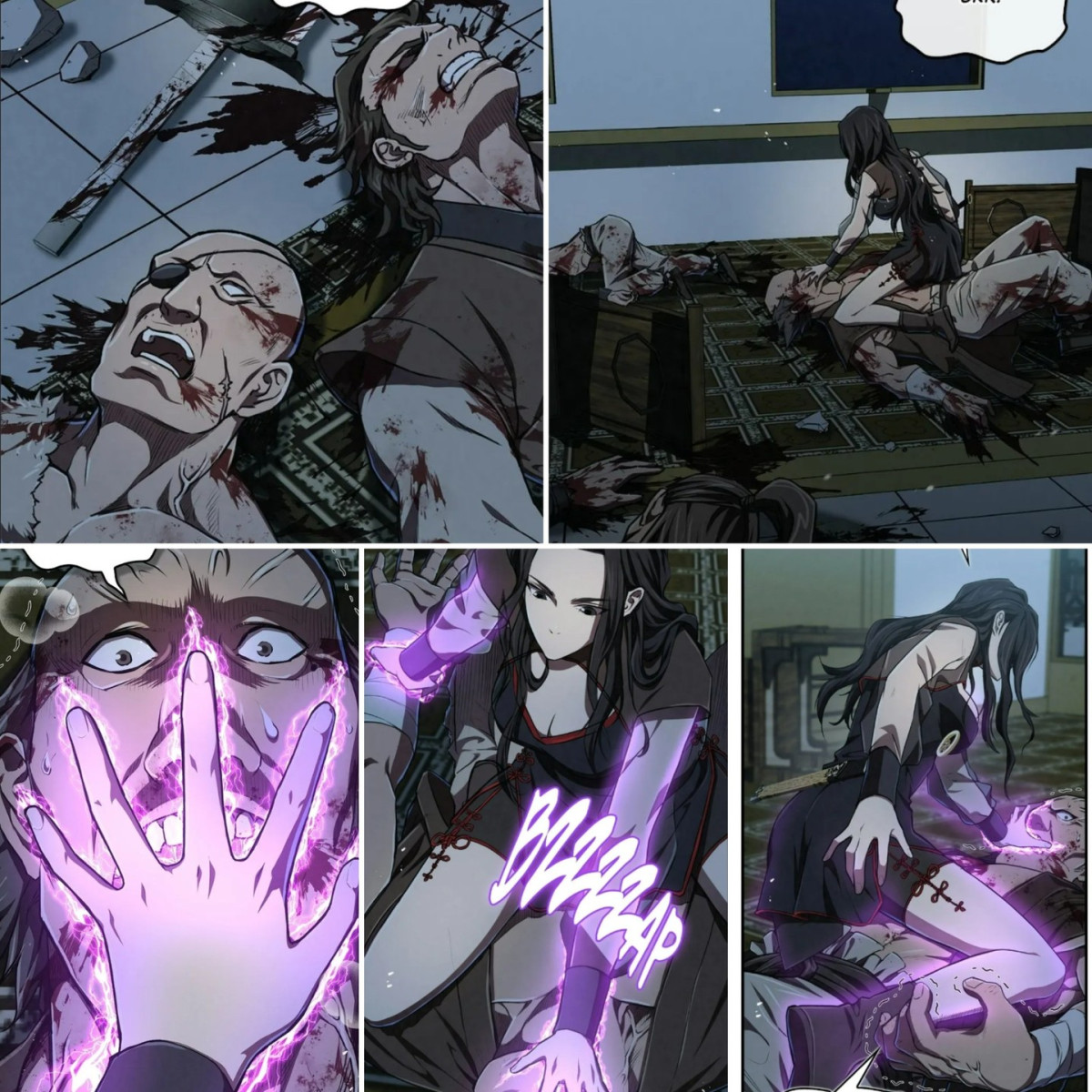
Jooheon collecting relics that everyone else dismissed as broken or useless and then repairing them into weapons is such a satisfying power fantasy. It rewards preparation and knowledge over brute strength.
Sign up to see more
SignupAlready a member?
LoginBy continuing, you agree to Sociomix's Terms of Service, Privacy Policy

Jooheon collecting relics that everyone else dismissed as broken or useless and then repairing them into weapons is such a satisfying power fantasy. It rewards preparation and knowledge over brute strength.
The article says this series will make you question the nature of talent. That is understating it. It made me question whether anything I work hard at is meaningful if the outcome is already determined by things outside my control.
That is a legitimate concern but the series addresses it somewhat by not really asking you to love Yu. It asks you to understand him, which is a different and arguably more interesting request.
The bit about Suho being more emotionally expressive than Jinwoo is accurate and it took me a while to warm up to that. Jinwoo's cold efficiency was part of his appeal.
Genuinely asking, which of these fifteen does everyone think has the highest chance of flopping? Not because the source is bad but because the production might not serve it well.
When you think of murim manhwa, your mind probably conjures images of ancient martial arts sects, internal energy cultivation, and warriors battling with swords and bare fists in historical settings. Science fiction elements like outer space invasions, advanced technology, and apocalyptic scenarios belong to completely different stories. Return of the Demonic Instructor takes these seemingly incompatible genres and weaves them into something genuinely innovative. Released on Webtoon in January 2026, this series arrived at the perfect moment when readers were hungry for fresh takes on established formulas. The premise alone sounds wild. A murim world gets invaded by demons from outer space, forcing martial artists to adapt centuries-old techniques to fight extraterrestrial threats. Then throw in regression, magic systems, and apocalyptic survival elements for good measure.
In a manhwa landscape dominated by dungeon crawling, regression narratives, and power fantasies, The Greatest Estate Developer stands out by asking a simple question: what if the protagonist's greatest weapon wasn't a sword or magic system, but civil engineering knowledge? This bizarre premise transforms into one of the most entertaining, genuinely funny, and surprisingly heartfelt series currently running, proving that innovation in storytelling comes from unexpected places. The series takes the familiar isekai setup where a modern person finds themselves in a fantasy world and completely subverts expectations. Instead of becoming an adventurer or hero, protagonist Kim Suho uses his engineering knowledge to revolutionize construction, infrastructure, and economic development. What sounds like it should be boring becomes absolutely captivating through sharp writing, excellent comedic timing, and genuine passion for showing how infrastructure improves lives.
Counterpoint to the people saying skip straight to Ragnarok, the original Solo Leveling is legitimately one of the most satisfying reads in modern manhwa. Don't rob yourself of that experience just to get to the sequel faster.
The year 2026 marks a pivotal moment in the evolution of manhwa as a medium. What started as a trickle of Korean comics receiving anime adaptations has become a flood, with at least fifteen confirmed projects bringing beloved manhwa to animated life. This explosive growth wasn't accidental but the inevitable result of Solo Leveling's massive success proving that manhwa adaptations can compete with traditional manga anime in quality, popularity, and profitability. Studios across Japan and Korea are investing heavily in manhwa properties, recognizing that Korean storytelling brings fresh perspectives, innovative premises, and built-in fanbases eager to see their favorite series animated. The diversity of genres receiving adaptations demonstrates that manhwa appeal extends far beyond action and fantasy into romance, psychological thriller, sports, and slice-of-life territories.
In a medium filled with talented artists producing stunning work, making a claim about any series having the "best" art feels bold. Yet Nano Machine consistently delivers combat sequences so fluid, detailed, and visually innovative that even readers who don't typically care about martial arts stories find themselves captivated by the sheer spectacle on display. The series combines traditional murim aesthetics with futuristic sci-fi elements, creating a unique visual identity that stands apart from typical cultivation manhwa. The nano machine implanted in protagonist Cheon Yeo-Woon's body doesn't just give him power. It becomes a storytelling device that allows the artist to visualize techniques, energy flows, and combat analysis in ways other series can't replicate.
The multi-file context awareness is actually the strongest argument for Windsurf over simpler tools. Once you are refactoring across a dozen files simultaneously, single-file autocomplete feels like using a notepad.
Characters who can't use the primary power system but compensate through intelligence and adaptation are always more interesting to me than overpowered cultivation prodigies.
Still not convinced this is fundamentally different from every other no-code wave we have seen. Remember when everyone said Webflow was going to replace frontend developers? Developers are still here.
If the ceasefire collapses and oil spikes back toward $110, this entire rally unwinds in about six hours. That's not pessimism, that's just how correlated risk assets are to energy prices right now.
The timeline issue is the thing I keep coming back to. Three to five years to first production silicon. The AI field moves so fast that what makes sense to optimize for today might be completely irrelevant by 2029. How do you even design for that uncertainty?
Does anyone know if the supply chain risk classification affects Anthropic's Amazon investment relationship since AWS is simultaneously a Glasswing partner? That seems like a genuine conflict of interest worth examining.
The artificial intelligence industry is entering a new phase of competition, one that extends far beyond the development of advanced language models and neural networks. Companies are now engaged in an intense struggle to secure the computational infrastructure necessary to train and deploy their AI systems. In this context, Anthropic has reportedly begun exploring the possibility of designing and manufacturing its own specialized processors to power Claude, its flagship conversational AI platform, along with its broader suite of artificial intelligence technologies. This strategic consideration emerges at a critical moment in the global AI sector. The exponential growth in model complexity and capability has created unprecedented demand for high-performance computing resources. Sources familiar with the matter indicate that Anthropic is conducting feasibility studies to determine whether developing proprietary semiconductor technology could reduce its dependence on external hardware vendors while ensuring reliable access to the computing power required for its operations.
Have you considered adding a leather belt with Celtic designs? It would enhance the medieval feel while creating more shape.
Love how the white tank and brown shorts combo gives such effortless summer vibes! I'd probably add some delicate gold necklaces to dress it up a bit