
Last year I was doing the classic noon to 8 pm fasting window and wondering why I felt fine but the metabolic markers at my checkup were still off. Switching to an earlier window genuinely changed those numbers.
15
Sign up to see more
SignupAlready a member?
LoginBy continuing, you agree to Sociomix's Terms of Service, Privacy Policy

Last year I was doing the classic noon to 8 pm fasting window and wondering why I felt fine but the metabolic markers at my checkup were still off. Switching to an earlier window genuinely changed those numbers.
Jaafar having grown up at Neverland and watching movies with his uncle is the kind of biographical detail that changes how you think about the performance. He is not playing a stranger.
The silence about studio and director is the real story here. Aniplex and Crunchyroll confirmed the project exists. Everything else including who is making it is still technically unknown publicly.
Started manhwa because the Solo Leveling anime made me impatient waiting for season 3 and now I have twelve series on my reading list. This genre is a trap in the best possible way.
Anime original endings are the bane of my existence so this point matters more than people realize.
It clicks around chapters 15 to 20 when the relic personalities start becoming a real storytelling element rather than just flavor text. First ten chapters are setup and worth pushing through.
Adaptation news has apparently been circulating for a while but nothing official. The challenge would be finding a studio that could do justice to the nano machine interface sequences, because cheap production would absolutely ruin what makes those moments work.
Honestly this is just Nano Machine energy but turned up to eleven with an alien invasion. Not a complaint, just an observation.
The AI video generation race just got a clear winner. Runway Gen-4.5 topped the Video Arena leaderboard with a 1,247 Elo score, surpassing both Google Veo 3 and OpenAI Sora 2. For those unfamiliar with Elo ratings, this is the same system used to rank chess players and competitive games. A higher score means more wins in head-to-head comparisons. When real users compare videos side by side without knowing which AI generated them, they consistently choose Runway's output. Runway didn't start as an enterprise video tool. It began as a playground for artists and filmmakers who wanted to experiment with AI-generated visuals. The early versions produced fascinating but inconsistent results. Sometimes you'd get stunning cinematic footage. Other times you'd get distorted motion and unrealistic physics. Gen-4.5 changed that equation by achieving breakthrough consistency in motion quality and physical accuracy.

Hot take: the real innovation here is not the technology, it is the interaction design. Dozens of tools had decent transcription before Descript. Nobody made editing the actual interface until Descript did.
Honestly the productivity angle is oversold a little. The tool saves time for the person who skipped, but everyone who showed up still sat through the full meeting. The meeting itself did not get shorter.
Fair critique, though the underlying data on customer growth is from independent research, not HeyGen's own marketing. The 152% figure is third-party sourced. The framing is optimistic but the core numbers appear to hold up.
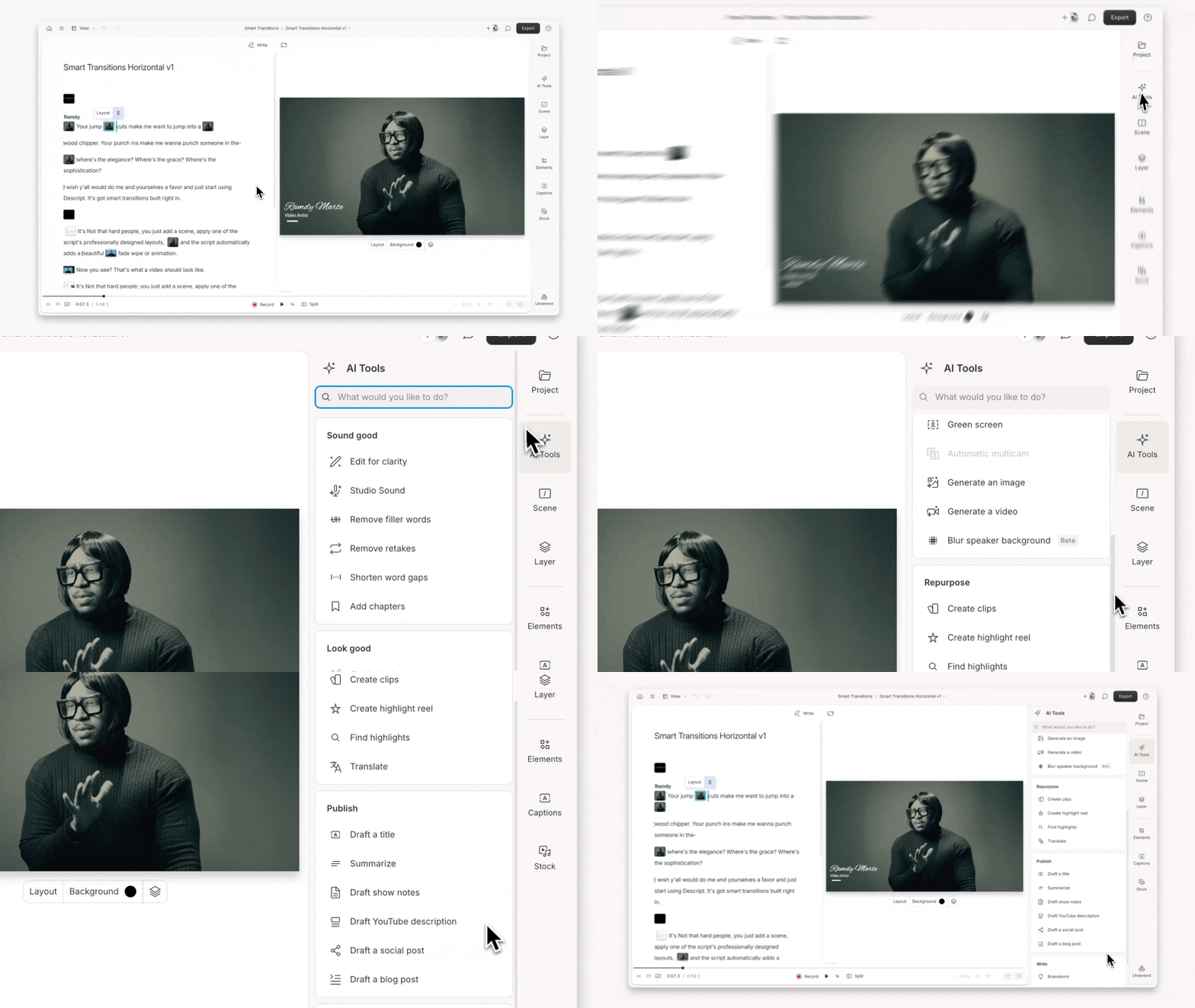
Most people can edit a Google Doc. Delete some words, rearrange sentences, fix typos, add paragraphs. It's intuitive and requires no special training. Now imagine editing video the same way. That's Descript's core innovation, and it transformed video editing from a specialized skill requiring expensive software into something anyone who can edit text can do effectively. Descript started as a transcription tool for podcasters. Record your podcast, upload it to Descript, and get an accurate transcript for show notes. But the founders realized something bigger. If you have a perfect transcript synchronized to audio, you can edit the audio by editing the text. Delete a word from the transcript and that word disappears from the audio. That insight became the foundation for a complete editing platform.
The law of financial gravity comment above deserves more attention. The assumption behind all of this is that compute costs keep falling faster than revenue growth so margins eventually normalize. If that assumption breaks, these burn rates become something much scarier.
When a company raises $200 million in Series E funding during January 2026, investors are betting on more than potential. They're backing proven market demand and sustainable growth. Synthesia's funding round came alongside a 44% year-over-year increase in headcount to 706 employees, signaling aggressive expansion in a category the company essentially created: AI avatar-based video generation for enterprise training and communications. Corporate training videos have been expensive and slow to produce for decades. Recording a single 10-minute training module traditionally required booking a studio, hiring a presenter, scheduling a videographer, managing multiple takes, and editing everything together. If you needed to update information or translate content, you essentially started over. Synthesia eliminated this entire production workflow by replacing human presenters with AI avatars.

There's a photograph from February 2026 that pretty much sums up the state of AI right now. At the India AI Impact Summit in New Delhi, Indian Prime Minister Narendra Modi invited the world's tech leaders onstage for a group photo. Everyone held hands. Well, almost everyone. Sam Altman of OpenAI and Dario Amodei of Anthropic, standing right next to each other, refused to clasp hands and instead raised their fists separately. The internet, predictably, lost its mind. An awkward moment between OpenAI CEO Sam Altman and Anthropic CEO Dario Amodei at an AI Summit captured the increasingly icy relations between two rival tech leaders who started off as colleagues. That's not just petty drama. It's a window into what may be the most consequential corporate rivalry in the technology world right now, one that's playing out in boardrooms, courtrooms, Super Bowl ads, and billion-dollar compute deals all at once.

The debugging experience when things go wrong is where this tool still feels rough. The AI autofix feature catches common errors, but when something breaks in a subtle way, the back-and-forth to diagnose it can consume more tokens than building the feature did.
Not gonna lie, the code-name being Avocado is doing a lot of work to make me like this company more than I probably should.
As someone who works in trust and safety at a tech company, the internal pressure to be able to scan DMs is enormous. Executives get called before parliament and asked why they let predators communicate freely. Encryption does not play well in those rooms.