Knowledge workers spend an average of 18 hours per week in meetings. Much of that time involves routine status updates, recurring check-ins, and informational sessions where your physical presence adds minimal value. Otter.ai introduced a provocative concept called OtterPilot: an AI assistant that joins meetings autonomously when you can't attend, records everything, generates summaries, and answers questions about what happened.
How OtterPilot Actually Works
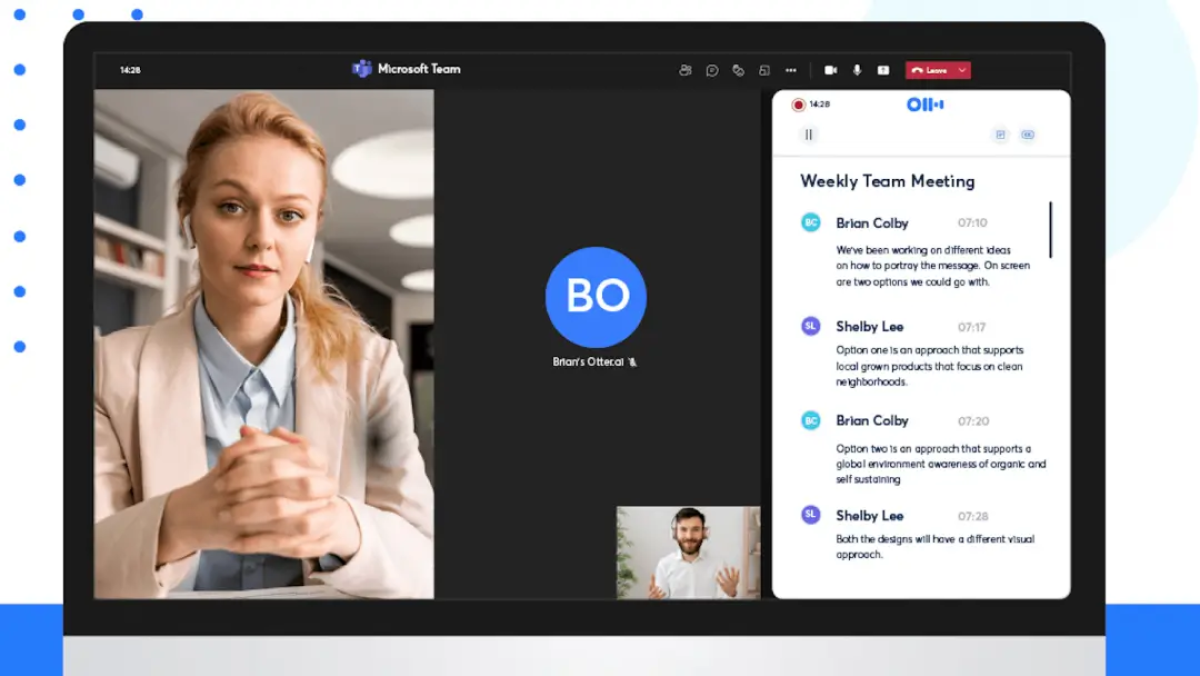
Connect Otter.ai to your calendar. The system monitors your scheduled meetings and automatically joins Zoom, Google Meet, or Microsoft Teams calls when they start. OtterPilot records audio, generates real-time transcripts, identifies speakers, and creates AI summaries with action items. You receive a meeting briefing without attending the meeting yourself.
This capability fundamentally changes meeting culture. You can skip routine meetings without missing critical information. Review the summary in three minutes instead of sitting through a 30-minute discussion. If something important emerges, search the transcript or ask the AI assistant questions about specific topics.
Real-Time Transcription Accuracy
Otter's transcription accuracy exceeds 95% with clear audio, making it reliable for important meetings where details matter. The real-time aspect means you can see transcripts appearing as people speak during live meetings. This real-time capability serves multiple purposes: accessibility for hearing-impaired participants, reference during discussions, and immediate searchability of what was just said.
Live Collaboration During Meetings
Team members can highlight important moments, add comments, and react to specific statements in real time while the meeting happens. This collaborative layer transforms passive listening into active engagement. Instead of everyone taking their own notes separately, the team builds a shared understanding with annotations and highlights visible to all participants.
AI Chat and Cross-Meeting Search
The AI chat feature allows natural language questions about meeting content. Ask "What did the marketing team decide about the campaign budget?" and get a direct answer pulled from relevant meeting transcripts. The cross-meeting search capability extends this power across all recorded meetings. Search your entire meeting history to find when specific topics were discussed or decisions were made.
Automated Summaries and Action Items
After each meeting, Otter generates a summary highlighting key decisions, action items, and important discussion points. The AI identifies who committed to what tasks and extracts deadlines from conversations. This automated documentation ensures nothing falls through the cracks and provides clear records of commitments and decisions.
Speaker Identification and Learning
Otter learns voices over time, improving speaker attribution with continued use. Early meetings might have some misidentified speakers, but the system learns from corrections and becomes increasingly accurate at recognizing who said what. This learning capability matters for teams with consistent participants across multiple meetings.
Integration with Workplace Tools
Otter integrates deeply with Zoom, Google Meet, Microsoft Teams, Salesforce, Slack, and other workplace platforms. The integration means Otter appears automatically in relevant meetings without manual setup for each call. Meeting notes sync to Salesforce for sales calls, Slack for team discussions, and project management tools for coordination meetings.
The Sales Team Use Case
Sales teams use Otter for call recording and analysis. Record customer conversations, review transcripts to identify objections and concerns, share insights with team members, and ensure follow-up actions get documented. Sales managers review calls without listening to full recordings, focusing on AI summaries and key moments highlighted by representatives.
The Journalist and Researcher Application
Journalists conducting interviews and researchers doing participant observations need accurate transcripts. Otter provides reliable transcription with timestamps, allowing easy reference to specific quotes. The ability to share transcripts with colleagues and search across multiple interviews creates efficiency that manual transcription cannot match.
Student and Educational Use
Students recording lectures can focus on understanding concepts rather than furiously taking notes. Review transcripts after class, search for specific topics covered weeks earlier, and share notes with classmates. Professors can make lectures more accessible by providing official transcripts for students who learn better through reading than listening.
The Remote Work Enabler
Distributed teams across time zones struggle with meeting scheduling. Otter enables asynchronous participation. Record meetings for team members in other time zones. They review summaries and transcripts when convenient, ask questions through comments, and stay informed without requiring everyone to attend live.
Privacy and Security Considerations
Otter allows meeting hosts to control recording permissions. Some organizations prohibit unauthorized recording, so Otter respects host settings and legal requirements. Enterprise plans include data retention controls, encryption, and compliance features necessary for regulated industries.
Pricing Tiers and Usage Limits
The free plan provides 300 minutes monthly with 30-minute conversation limits. Pro plans at $16.99 monthly include 1,200 minutes, advanced export, and priority support. Business plans at $30 per user monthly add admin controls, Salesforce integration, and usage analytics. Enterprise plans offer custom pricing with SSO, custom retention, and dedicated support.
The Behavioral Change
Teams using Otter report changed meeting behavior. Discussions become more focused when everyone knows accurate records will be available. People feel less pressure to attend every meeting when they can catch up through summaries. Meeting culture shifts from attendance-based to outcome-based, measuring value by decisions made rather than time spent.
Accuracy Comparison with Competitors
Independent testing shows Otter edges out alternatives in transcription accuracy, particularly with challenging audio. The Studio Sound-style enhancement that competitors like Descript offer isn't built into Otter, but the core transcription engine handles imperfect audio better than most alternatives. For real-time accuracy during live meetings, Otter delivers minimal lag and high reliability.
The Assistant Evolution
Otter evolved from transcription tool to meeting assistant to what the company calls a "meeting brain." The AI doesn't just record and transcribe anymore. It understands context, tracks decisions across time, identifies patterns in recurring meetings, and proactively surfaces relevant information. This evolution from passive tool to active assistant represents where workplace AI is heading generally.
The Trust Factor
Otter built trust by consistently delivering accurate transcripts and respecting privacy controls. Users trust the transcripts enough to reference them in legal contexts, customer interactions, and critical business decisions. That trust took years to build through reliability and accuracy, creating a moat that newer competitors struggle to overcome.
The Meeting Attendance Revolution
The provocative idea that you don't need to attend every meeting challenges deep cultural assumptions about professional presence and engagement. Early adopters who embrace this capability gain time advantage over peers still treating every meeting invite as mandatory. As tools like Otter normalize asynchronous meeting participation, workplace culture will likely shift toward outcome focus over presence theater.
The concept of an AI attending meetings on your behalf felt like science fiction just a few years ago. Now it's standard practice for hundreds of thousands of knowledge workers who realized that being informed doesn't require being present. That cultural shift, enabled by technology that actually works, represents Otter.ai's lasting impact beyond just transcription features.
Journalists and researchers using this for interviews should really think hard about where that audio goes and whether it gets used to train models. Source confidentiality is not abstract, it is a professional obligation.
Does the free plan actually work for normal use, or is the 300 minutes monthly limit a constant wall? Asking because that is less than one hour per week for a single person.
True but impractical. You cannot fix your company's meeting culture alone. Tools that let you adapt while culture slowly changes are genuinely useful in the meantime.
As someone who works in HR, the scenario where an employee records a performance improvement plan conversation using a personal AI tool without the manager knowing is genuinely something employment attorneys are flagging right now. Policies need to catch up.
The article says transcription accuracy exceeds 95% with clear audio. That qualifier, with clear audio, is doing a lot of heavy lifting. Home offices, open floor plans, overlapping speakers, accents. Real conditions are messier than the demo.
What is the etiquette when you send OtterPilot to a meeting with external clients who never agreed to be recorded? That feels like a relationship risk beyond just the legal one.
The slide capture feature is something the article barely mentions but it is actually excellent. Having the slide image embedded right next to the relevant transcript section means you never lose the visual context.
My company just banned third-party AI notetakers in any meeting involving outside counsel. Legal team was pretty clear that having conversation data on a third-party server creates attorney-client privilege problems.
As someone who manages a distributed team across four time zones, the async angle is the part that actually changed how we operate. Not everyone skipping meetings, but people in Singapore not having to join a 10pm call just to stay informed.
One thing the article missed is what happens when the AI gets the summary wrong. A 95% accurate transcript means roughly 1 in 20 words is off. In a 30-minute meeting that could mean a meaningfully distorted action item or a misquoted decision. Someone still needs to verify.
One thing nobody mentions is that these tools change how people speak in meetings. People become more deliberate, clearer, less casual. That can be good and bad depending on whether you value authenticity over tidiness.
The consent issue here is not small. There is actually an active class action lawsuit against Otter right now alleging that the tool recorded conversations without the informed consent of all participants, not just the meeting host. That is a significant legal exposure people should know about before deploying this at scale.
The article frames skipping meetings as purely positive but there is a coordination cost to having some attendees fully present and others catching up asynchronously. Decisions that seemed clear in the room often need re-litigating for the async people.
For anyone in healthcare, the HIPAA compliance Otter achieved last year matters enormously. Clinical teams that were locked out of these tools for compliance reasons now have a path to use them for documentation and care coordination.
As someone who recently switched from a competitor, the real-time aspect of Otter is what differentiates it. Seeing the transcript appear as people speak during the live call, not just as a post-meeting artifact, is genuinely more useful.
Hot take: AI meeting summaries are training people to stop paying attention during meetings they do attend, because they know a summary is coming anyway.
The Salesforce integration is a real productivity multiplier for sales teams. Having call summaries, objections, and action items land in the CRM automatically without manual logging is hours back per week per rep.
Does it handle overlapping voices well? In my team's meetings two people often talk simultaneously and I worry that either the transcript breaks or attributes statements to the wrong person.
Presence theater is the most honest description of corporate meeting culture I have seen in print. The entire performance of sitting attentively in a call you had no reason to attend is so pervasive it became invisible until tools like this held a mirror to it.
Speaking from experience in a large enterprise environment, rolling this out without a governance policy first is how you end up with sensitive HR conversations and legal strategy sessions sitting on third-party servers indefinitely. The article treats privacy as a solved problem and it is not.
Been using this for academic research interviews and it has been transformative. Timestamps on every quote means I can jump directly to the relevant audio segment for verification. Old way was genuinely painful.
The enterprise data retention and compliance features matter a lot more than people realize until they are in a regulated industry. Healthcare teams should note that Otter achieved HIPAA compliance last year, which changes the calculus for clinical documentation teams.
The part about discussing Otter in legal contexts is complicated right now given the active litigation challenging whether the tool records people without their consent. The trust story and the lawsuit story are running simultaneously.
The voice learning feature combined with biometric privacy laws is actually a lawsuit waiting to happen. Illinois and Texas have explicit rules about collecting voiceprints without written consent, and the tool does exactly that.
The biometric angle is underappreciated. Voice identification over time means the tool is building a voiceprint of every participant. Illinois has a specific biometric privacy law that this could run afoul of, and a separate Fireflies lawsuit was filed over exactly this issue.
Overlapping speakers is probably the weakest point of the current generation of transcription tools including Otter. It typically picks the louder voice or just generates a garbled fragment. Not a dealbreaker but worth knowing.
The competitive comparison with Microsoft Copilot is interesting. Copilot is baked into Teams natively, which is a distribution advantage. Otter is better on transcription accuracy but Copilot wins on not needing another tool.
Sending a bot to a meeting instead of attending should require telling the other participants first. It should not be something you can do silently. The transparency norm should be explicit.
The sales team use case is the most compelling one for me. Reviewing AI summaries of 20 calls a week instead of listening to recordings is a massive time unlock for managers.
This is the kind of tool that sounds great in the pitch and then causes a compliance crisis eighteen months after deployment when nobody thought to ask about data governance. Ask first.
The AI is evolving fast enough that the version described in this article is already behind what the tool can do now. The voice-activated agent that can actually respond during a live meeting is a different category of product than a transcription tool.
Does anyone know if participants get notified when OtterPilot joins a meeting? Like, does it announce itself or just silently appear in the participant list?
The 300 minute free tier is pretty limiting for any real meeting schedule. If you have more than a couple hours of meetings weekly you will hit the ceiling fast. Pro plan is almost necessary for regular use.
Accessibility angle deserves way more attention than it gets. Real-time transcription for deaf and hard-of-hearing participants is not a nice-to-have feature, it is a genuine equity tool.
The shift from passive tool to active meeting agent is the most interesting development. The new Meeting Agent can actually answer questions asked aloud during a live call, which is a different category of thing than transcription.
Using it for graduate research and the ability to search across all interviews at once instead of re-listening is genuinely life-changing. I can find every instance a participant mentioned a specific concept in seconds.
The claim that this builds trust because people reference transcripts in legal contexts is doing a lot of work given the active litigation currently challenging whether this tool violated recording laws. Trust is complicated.
My honest review after six months of daily use: transcription accuracy is excellent in quiet environments, mediocre in meetings with more than five people talking, and the summaries occasionally miss subtle but important context. Know the limits.
Counterpoint to the meeting skipping enthusiasm: some meetings exist for relationship maintenance, not information transfer. You can get the info but miss the relationship. AI cannot capture that.
The ROI math is compelling at scale. If the enterprise claim of saving one FTE worth of work per 20 users is even half true, the payback period on the subscription is measured in weeks.
My whole team adopted this and meetings genuinely got more focused. When people know the record exists they trim the rambling. Funny side effect nobody mentions.
The data governance question is the one I keep coming back to. Your meeting transcripts are now on a third-party server, subject to that company's data practices, potentially used to train their models, and potentially discoverable in any future litigation. That is a non-trivial thing you are signing up for.
From a purely practical standpoint, the ability to search three months of meeting history and find the specific conversation where a decision was made is worth whatever the subscription costs. That alone has saved relationships in my team.
The cross-meeting search feature is the sleeper hit here. Being able to ask what was decided about a budget three weeks ago and actually get an answer is worth the subscription alone.
Wait, what about the people who didn't consent to being recorded? The article breezes past the privacy section really fast, but this is genuinely complicated in states like California, Illinois, and Florida where all-party consent is required before recording a conversation.
Used this for three months straight and the time savings are genuinely real. Reclaiming even two hours a week back from pointless status updates feels like getting a raise.
Spent two years manually transcribing ethnographic fieldwork recordings. Would have wept with joy to have this. The time cost of transcription is invisible to people who have never done it.
Outcome-based meeting culture over attendance-based is a genuinely good idea that should have happened twenty years ago. The AI is just forcing a long overdue conversation.
Technical jargon is hit or miss in my experience. Common industry terms do okay. Very specialized or regional nomenclature can get garbled in ways that are worse than a gap because the error looks plausible.
Had Otter join a sensitive one-on-one performance conversation before my team had a policy around it. The employee was visibly uncomfortable. Some discussions genuinely should not be transcribed and organizations need clear rules about when this runs.
To answer the question above, yes, it typically shows up as a participant named Otter Notetaker or something similar in the meeting list. Whether everyone notices or reads it is a different question. The notification is there but easy to miss if you are not looking.
Having Otter auto-join every calendar event including informal chats with my skip-level manager felt like overkill fast. Learned to be selective about which meetings get the bot.
The speaker identification learning over time feature is clever in theory but in my experience it still muddles voices when two people have similar vocal registers. Corrections help but it takes a while.
As someone who works in legal services, the discovery risk here is not theoretical. Permanent searchable records of internal business discussions are exactly what opposing counsel subpoenas. Your candid meeting conversations become a liability.
The fact that Otter passed 35 million users and has processed over a billion meetings says something important about how normalized this has become, very fast.
Outcome focus over presence theater is the culture shift that actually matters here. The tool is almost secondary, the real question is whether your organization is willing to judge people by what they produce rather than whether they sat in a room.
The productivity stat that 62% of users reclaim four or more hours per week sounds like it came from a survey Otter ran about its own users. Should be taken as directional rather than independent evidence.
Genuinely curious how the AI handles highly technical jargon. Medical terms, legal Latin, engineering acronyms. Does it transcribe those correctly or make plausible sounding errors that are actually wrong?
The phrase meeting brain is doing a lot of marketing work. What it actually is is a very good persistent searchable archive of conversations. That is genuinely valuable but brain oversells it.
Respectfully disagree with the framing that skipping meetings is automatically good. Some of the most valuable moments in a meeting are the informal exchanges, the tone of a discussion, the hesitation before someone answers. None of that survives into a transcript.
Teams with consistent participants get better speaker attribution over time according to the article. That is genuinely useful for recurring standups where you want to track who said what across weeks.
The language expansion to French, Spanish, and Japanese is genuinely important for global teams. Translation-quality transcription in those languages removes a significant friction point for multinational orgs.
The action item extraction is impressive when it works. The AI correctly identified who committed to what in three separate discussions during a product planning session and got it right each time. That surprised me.
For students with disabilities this is not a productivity hack, it is a fundamental accommodation. Having searchable transcripts of lectures removes a significant barrier that manual note-taking creates for people with processing or motor difficulties.
There is a federal lawsuit in the Northern District of California right now specifically challenging whether tools like this violate the Electronic Communications Privacy Act. The legal picture around these tools is actively unsettled.
Honestly the productivity angle is oversold a little. The tool saves time for the person who skipped, but everyone who showed up still sat through the full meeting. The meeting itself did not get shorter.
If this becomes universal, nobody will attend any meeting and all meetings will be AI talking to other AI. This is either utopia or the logical endpoint of corporate dysfunction.
Good point above. Skipping attendance does not fix meeting culture, it just creates a two-tier system where some people are present and others are ghosts consuming summaries.
Hot take: the real winner here is not productivity. It is accountability. When everything is recorded and searchable, vague commitments and verbal agreements that were never followed up on become visible. That changes behavior faster than any management system.
The etiquette question is real. Some clients will feel surveilled. Others will be fine with it. Telling them upfront seems obviously correct but I wonder how many people actually do.
Nobody talks about the social pressure angle. If your AI always attends meetings so you can skip them, colleagues notice. There is a professional presence dimension that does not disappear just because the tool is good.
Speaking from experience running remote engineering standups, the async participation feature genuinely reduced meeting bloat. Engineers in Europe stop getting scheduled for 8am calls just to hear updates they can read in three minutes.
Otter just hit 100 million in annual recurring revenue, which tells you the market demand is real. This is not a novelty tool anymore, it is infrastructure.
This whole category of tool is creating permanent, searchable corporate memory that did not exist before. Think about what that means for institutional knowledge, but also for what happens during layoffs or acquisitions when those records transfer.