Honestly felt seen reading the part about calorie apps making you miserable. I spent three years logging every bite and lost basically nothing while feeling constantly surveilled by my own phone.
22
Sign up to see more
SignupAlready a member?
LoginBy continuing, you agree to Sociomix's Terms of Service, Privacy Policy

Honestly felt seen reading the part about calorie apps making you miserable. I spent three years logging every bite and lost basically nothing while feeling constantly surveilled by my own phone.
From what has been reported, Jaafar worked with professional choreographers and also had access to private family footage and Michael's personal rehearsal materials. So it was a combination of formal training and that insider family access no outside actor could replicate.
The creators behind some of Webtoon's most successful psychological thrillers have returned with a series that's already generating intense discussion across manhwa communities. For fans who've been following the horror and thriller genre on digital platforms, Carnby Kim and Youngchan Hwang need no introduction. Their latest collaboration tackles themes of artistic plagiarism, obsession, and murder in ways that feel disturbingly relevant to current conversations about creative theft and AI-generated content. This guide covers everything you need to know about Copycat, from its premise and release schedule to how it compares with their previous masterpieces like Sweet Home and Bastard.

If you told me two years ago that I'd be more emotionally invested in a sequel protagonist than in Jinwoo himself at certain points, I would not have believed you. Suho gets there.
This was always going to appeal to the Solo Leveling crowd but I think the globe-trotting exploration element has the potential to pull in a completely different audience who would not normally watch dungeon fantasy.
Eleceed and Gosu both have release windows described as unconfirmed but the article treats them as if they are definitely 2026 entries. That is doing a lot of work for a list of fifteen supposedly confirmed adaptations.
When Tomb Raider King first exploded onto the manhwa scene, it brought a fresh take on dungeon crawling stories by combining archaeological adventure with ruthless protagonist energy and a treasure-hunting premise that felt genuinely different from typical gate and dungeon narratives. The series built a dedicated fanbase through its satisfying blend of historical artifact powers, strategic relic acquisition, and a protagonist who wasn't afraid to be morally gray in pursuit of his goals. Now, with the anime adaptation confirmed for 2026 as one of the most anticipated manhwa-to-anime projects, Tomb Raider King is experiencing a resurgence. New readers are discovering the series while longtime fans eagerly await seeing Jooheon Suh's relic-hunting adventures brought to life with animation. The timing couldn't be better, as the series has built enough content to support a substantial adaptation while maintaining momentum in its ongoing storyline.

The year 2026 marks a pivotal moment in the evolution of manhwa as a medium. What started as a trickle of Korean comics receiving anime adaptations has become a flood, with at least fifteen confirmed projects bringing beloved manhwa to animated life. This explosive growth wasn't accidental but the inevitable result of Solo Leveling's massive success proving that manhwa adaptations can compete with traditional manga anime in quality, popularity, and profitability. Studios across Japan and Korea are investing heavily in manhwa properties, recognizing that Korean storytelling brings fresh perspectives, innovative premises, and built-in fanbases eager to see their favorite series animated. The diversity of genres receiving adaptations demonstrates that manhwa appeal extends far beyond action and fantasy into romance, psychological thriller, sports, and slice-of-life territories.

The constellations becoming full characters with distinct personalities and political agendas is where I went from liking this story to being completely obsessed with it. The Secretive Plotter alone justified the entire premise.
In a manhwa landscape dominated by dungeon crawling, regression narratives, and power fantasies, The Greatest Estate Developer stands out by asking a simple question: what if the protagonist's greatest weapon wasn't a sword or magic system, but civil engineering knowledge? This bizarre premise transforms into one of the most entertaining, genuinely funny, and surprisingly heartfelt series currently running, proving that innovation in storytelling comes from unexpected places. The series takes the familiar isekai setup where a modern person finds themselves in a fantasy world and completely subverts expectations. Instead of becoming an adventurer or hero, protagonist Kim Suho uses his engineering knowledge to revolutionize construction, infrastructure, and economic development. What sounds like it should be boring becomes absolutely captivating through sharp writing, excellent comedic timing, and genuine passion for showing how infrastructure improves lives.

As someone who has never played an RPG in my life, I picked up Solo Leveling on a whim and finished it in a week. The article is right that you don't need any gaming background at all.
Developers have been telling designers for years that their mockups are not realistic. Designers have been telling developers that the implementation is sloppy. Both are partially right. v0 is interesting because it sidesteps the blame entirely.
What gets lost in the speed conversation is testability. AI-generated code often lacks unit tests, edge case handling, and error states that a thoughtful developer would include. Those gaps bite you later.
Nobody ever posts the failure stories though. The channels that went all in on AI avatars and lost audience trust when they disclosed it, the agencies whose clients pulled back when they found out. Survivorship bias makes every case study look cleaner than reality.
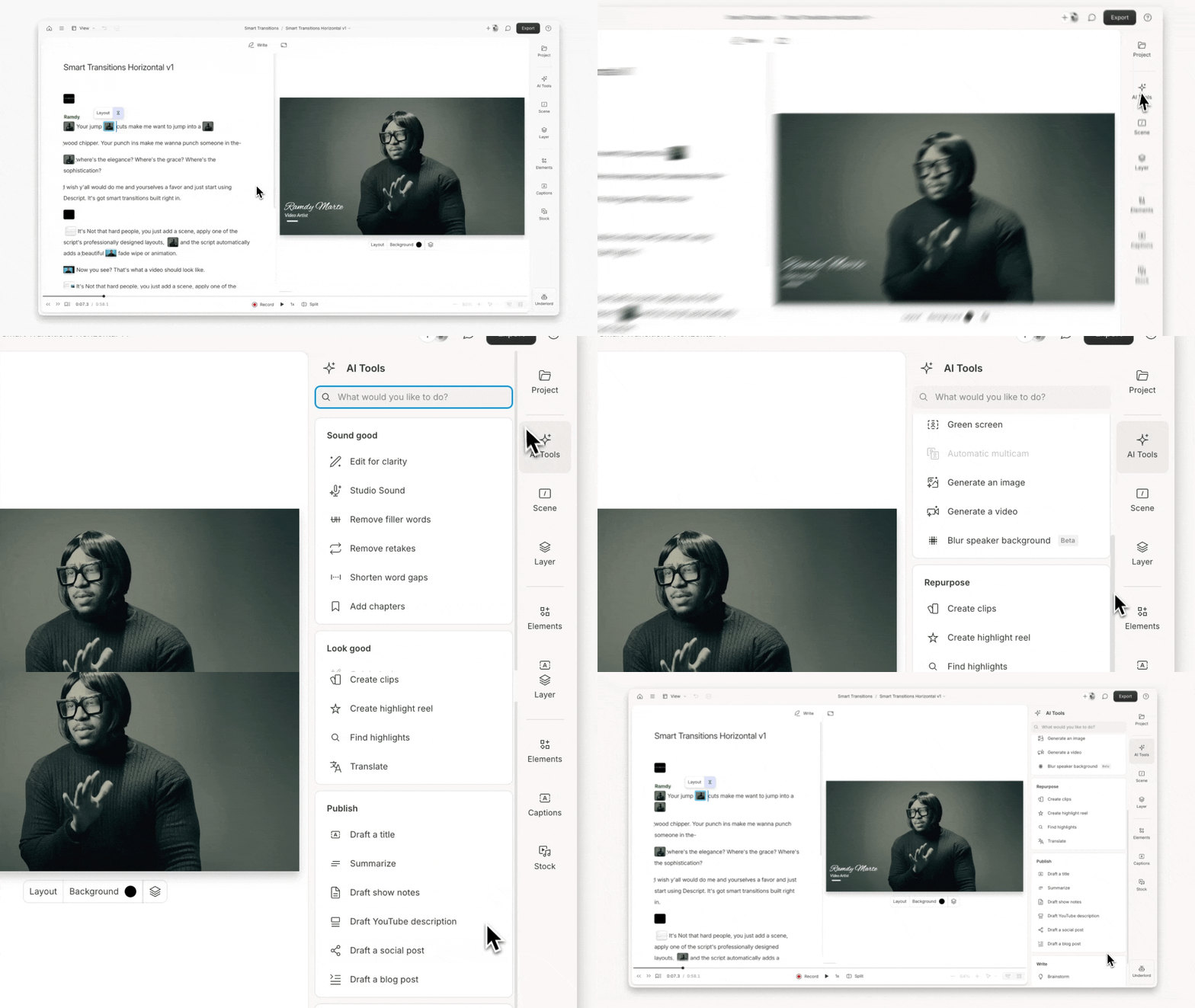
Most people can edit a Google Doc. Delete some words, rearrange sentences, fix typos, add paragraphs. It's intuitive and requires no special training. Now imagine editing video the same way. That's Descript's core innovation, and it transformed video editing from a specialized skill requiring expensive software into something anyone who can edit text can do effectively. Descript started as a transcription tool for podcasters. Record your podcast, upload it to Descript, and get an accurate transcript for show notes. But the founders realized something bigger. If you have a perfect transcript synchronized to audio, you can edit the audio by editing the text. Delete a word from the transcript and that word disappears from the audio. That insight became the foundation for a complete editing platform.
the compute math here is brutal for OpenAI. Spending 4x more on training and generating less revenue is not a gap you close by writing memos to investors.
The window between vulnerability discovery and active exploitation has collapsed from months to minutes. That single sentence from the Mythos disclosure should be on the front page of every financial regulator's briefing book.
Not gonna lie, the idea of AI being the default interface for everything is either the most exciting or most dystopian sentence in this piece depending on what kind of week you are having.
The artificial intelligence industry is entering a new phase of competition, one that extends far beyond the development of advanced language models and neural networks. Companies are now engaged in an intense struggle to secure the computational infrastructure necessary to train and deploy their AI systems. In this context, Anthropic has reportedly begun exploring the possibility of designing and manufacturing its own specialized processors to power Claude, its flagship conversational AI platform, along with its broader suite of artificial intelligence technologies. This strategic consideration emerges at a critical moment in the global AI sector. The exponential growth in model complexity and capability has created unprecedented demand for high-performance computing resources. Sources familiar with the matter indicate that Anthropic is conducting feasibility studies to determine whether developing proprietary semiconductor technology could reduce its dependence on external hardware vendors while ensuring reliable access to the computing power required for its operations.
Wait, what about smaller companies that also run critical infrastructure? A 50-person fintech running legacy code is not getting access to this, but they are just as vulnerable as anyone on the partner list.