The scene I keep seeing clips of where Jaafar teaches the gang members the Beat It choreography looks genuinely electric. That specific moment is apparently one of the most praised sequences in the whole film.
18
Sign up to see more
SignupAlready a member?
LoginBy continuing, you agree to Sociomix's Terms of Service, Privacy Policy

The scene I keep seeing clips of where Jaafar teaches the gang members the Beat It choreography looks genuinely electric. That specific moment is apparently one of the most praised sequences in the whole film.
Bio-harmony eating is the nutrition trend reshaping how people think about food in 2026, and if you have been feeling like calorie counting is making you miserable without actually delivering results, the science behind it will likely resonate immediately. The concept is straightforward - instead of obsessively tracking numbers on a label, you align what you eat, when you eat it, and how much with your body's internal biological clock, your metabolic rhythms, and your gut's own needs. After spending several months testing this approach, shifting my own meals earlier in the day and rebuilding my eating window around natural light cycles, the difference in energy levels and digestion alone was enough to keep me from ever going back to a calorie app. This guide covers what bio-harmony eating actually is, the real science behind it, what a typical day looks like in practice, and who is most likely to benefit.

A part two that addresses the allegations head on would be commercially radioactive and the estate would never approve it. The His Story Continues tagline is either wishful thinking or the most optimistic end card in cinema history.
The decision to present the Pepsi burn as a triumph of willpower rather than the beginning of a serious addiction is exactly the kind of choice that makes this film feel like PR rather than art.
Can someone explain what daily pass means for webtoon reading? I keep seeing it mentioned but I am new to the platform.
The meta-narrative element is interesting but it also has the potential to become the thing that prevents real emotional investment. If the protagonist is always watching the story rather than living it, the romance can feel like it is happening to a spectator.
SSS-Class Revival Hunter should absolutely have been on this list. A protagonist who gains powers by dying repeatedly is one of the most creative mechanics the genre has ever produced.
Reading this made me want to go start from the very first chapter again. The setup is so deceptively simple and then slowly reveals itself to be something much bigger and stranger.
Hot take but The Gamer is massively overrated as a starting point. The early chapters are fun but the story meanders so badly that most beginners will drop it before it gets interesting.
What really makes this different from other comedy isekai is that the comedy never undercuts the actual narrative stakes. When things get serious the jokes stop and the series earns it.
The magic system feels like it's still being established in the earlier chapters. From what I can tell it operates through external formulas rather than internal energy refinement, which is a meaningful distinction that becomes important later.
One thing nobody mentions: the transcript is searchable. When you have 200 episodes of a podcast you can search for any word or phrase and jump directly to that moment across your entire archive. That use case alone is worth the subscription.
The article makes the ROI case almost entirely on cost reduction. That is the right argument for procurement but it is the wrong framing for learning strategy. We should be asking whether people are actually better at their jobs afterward.
Speaking from experience in advertising production, the team workspace features are the most underappreciated part of this. Leaving frame-level feedback without sending files back and forth is the kind of workflow improvement that actually saves hours per project.
The article frames skipping meetings as purely positive but there is a coordination cost to having some attendees fully present and others catching up asynchronously. Decisions that seemed clear in the room often need re-litigating for the async people.
Tower climbing stories have become a dominant force in manhwa, but most follow predictable patterns. A protagonist enters a mysterious tower, gains powers, forms a party, and ascends floors while growing stronger. The formula works because progression feels satisfying and each floor presents new challenges. However, Doom Breaker takes this familiar framework and transforms it into something far more emotionally devastating and psychologically complex than typical tower stories. Also known as SSS-Class Suicide Hunter, Doom Breaker initially appears to be another power fantasy where the protagonist gains an overpowered ability. The premise sounds almost comedic. Kim Gongja can copy any skill by dying, then returns to life to use that ability. But beneath this seemingly absurd power lies a story about pain, sacrifice, redemption, and what it truly means to be a hero when heroism demands everything from you.

The custom executive avatar feature is going to create some genuinely uncomfortable situations. Imagine your CEO avatar delivering a message that the real CEO never actually approved in those exact words.
Developers have a new anxiety in 2026: token anxiety. You're in the middle of debugging a complex problem, the AI is helping you refactor three files simultaneously, and suddenly you wonder if this session is about to cost you $50. That mental tax slows you down and makes you second-guess using the tool you're paying for. Windsurf eliminated that anxiety with a simple decision: flat monthly pricing with no token limits. Fifteen dollars per month. Unlimited usage. No tracking credits or calculating costs per query. That pricing model sounds almost boring compared to the complex token systems other AI coding tools use, but boring is exactly what professional developers want when it comes to pricing. They want predictable costs and unlimited usage so they can focus on writing code instead of budgeting AI queries.

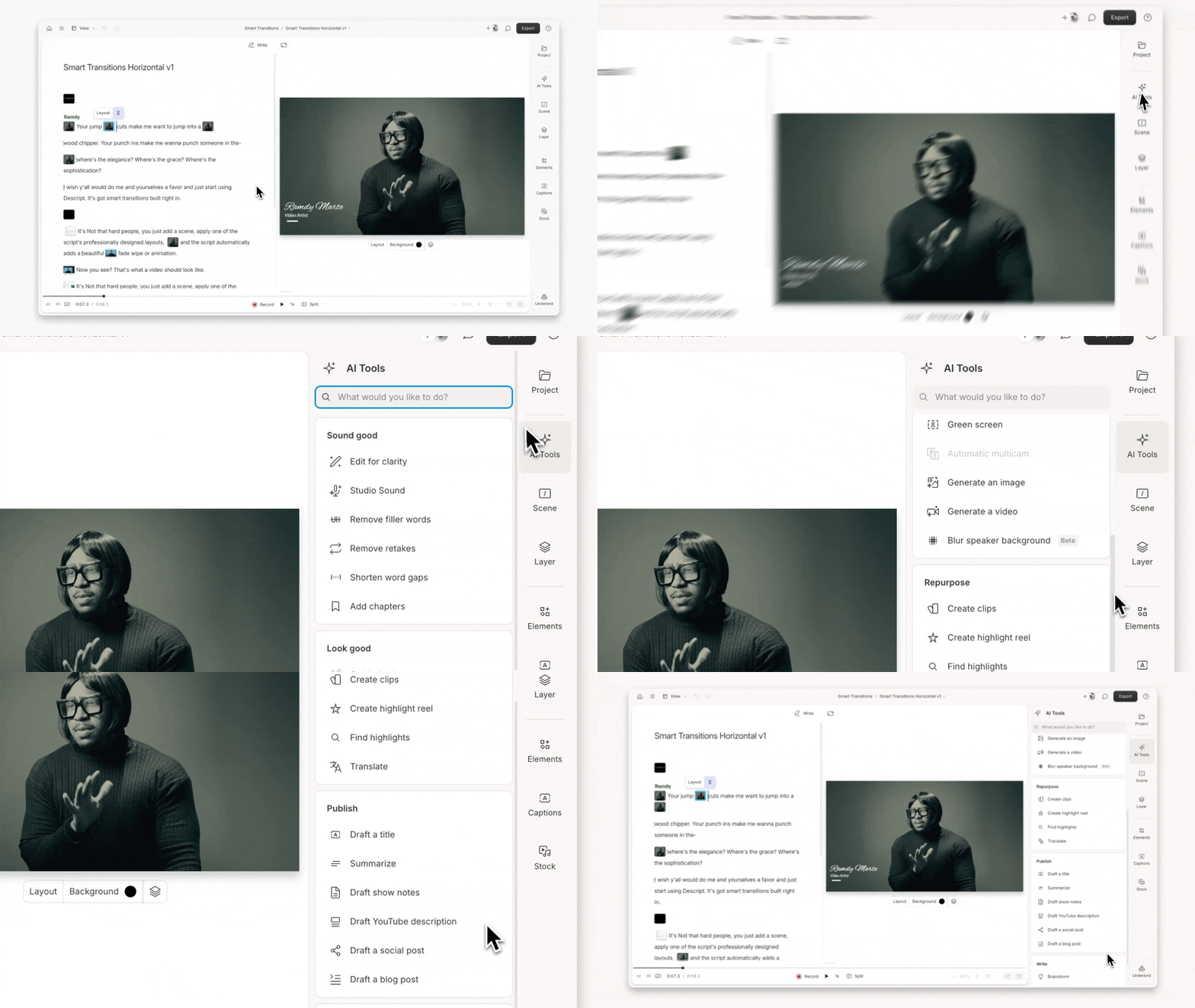
Most people can edit a Google Doc. Delete some words, rearrange sentences, fix typos, add paragraphs. It's intuitive and requires no special training. Now imagine editing video the same way. That's Descript's core innovation, and it transformed video editing from a specialized skill requiring expensive software into something anyone who can edit text can do effectively. Descript started as a transcription tool for podcasters. Record your podcast, upload it to Descript, and get an accurate transcript for show notes. But the founders realized something bigger. If you have a perfect transcript synchronized to audio, you can edit the audio by editing the text. Delete a word from the transcript and that word disappears from the audio. That insight became the foundation for a complete editing platform.
Good point on the health feature. As someone who has seen health misinformation spread across Facebook for a decade, handing that same platform an AI that gives people health guidance feels like it needs some serious oversight before the hype machine runs this far ahead.