The article mentions fermented foods being more effective at breakfast than as late night snacks. Has anyone actually tested kefir at breakfast specifically and noticed a difference versus other times?
Sign up to see more
SignupAlready a member?
LoginBy continuing, you agree to Sociomix's Terms of Service, Privacy Policy
Sign up to see more
SignupAlready a member?
LoginBy continuing, you agree to Sociomix's Terms of Service, Privacy Policy

The article mentions fermented foods being more effective at breakfast than as late night snacks. Has anyone actually tested kefir at breakfast specifically and noticed a difference versus other times?
I keep seeing people online ask whether Jaafar Jackson is a good actor or just a skilled impersonator. The article addresses this honestly and I think the answer is both, depending on which scenes you are watching.
Brain wealth is the lifestyle concept redefining how an entire generation thinks about mental health in 2026, and if you have been treating your cognitive fitness as something to address only when something goes wrong, the shift happening right now will feel either overdue or quietly alarming depending on where you stand. The idea is straightforward but the implications are significant: your cognitive capacity, your ability to focus, adapt, learn, regulate your emotions, and think clearly under pressure, is not a fixed trait you are born with. It is a long-term asset you can actively invest in, protect, and grow.
As a long-time Bastard reader, I was slightly nervous about Copycat because sometimes creators peak and then coast. Ten chapters in I can confirm this is absolutely not coasting. Kim seems genuinely energized by this premise.
The demonic versus orthodox visual coding is so ingrained now that when Cheon Yeo-Woon uses orthodox-adjacent techniques the color confusion reads as intentional character development. That is artist and writer working in perfect sync.
In a manhwa landscape dominated by dungeon crawling, regression narratives, and power fantasies, The Greatest Estate Developer stands out by asking a simple question: what if the protagonist's greatest weapon wasn't a sword or magic system, but civil engineering knowledge? This bizarre premise transforms into one of the most entertaining, genuinely funny, and surprisingly heartfelt series currently running, proving that innovation in storytelling comes from unexpected places. The series takes the familiar isekai setup where a modern person finds themselves in a fantasy world and completely subverts expectations. Instead of becoming an adventurer or hero, protagonist Kim Suho uses his engineering knowledge to revolutionize construction, infrastructure, and economic development. What sounds like it should be boring becomes absolutely captivating through sharp writing, excellent comedic timing, and genuine passion for showing how infrastructure improves lives.
Suho using gauntlets instead of daggers is such a small thing but it does a lot of work in making him feel like his own character instead of just Jinwoo version two.
For the person asking about how much to read before the anime, getting through the first 50 to 60 chapters gives you a solid foundation without spoiling most of the major arcs. The first season will almost certainly adapt that range anyway.
The fact that this series is rated Young Adult on Webtoon while dealing with brainwashing, psychological trauma, and apocalyptic horror is doing a lot of work.
When Tomb Raider King first exploded onto the manhwa scene, it brought a fresh take on dungeon crawling stories by combining archaeological adventure with ruthless protagonist energy and a treasure-hunting premise that felt genuinely different from typical gate and dungeon narratives. The series built a dedicated fanbase through its satisfying blend of historical artifact powers, strategic relic acquisition, and a protagonist who wasn't afraid to be morally gray in pursuit of his goals. Now, with the anime adaptation confirmed for 2026 as one of the most anticipated manhwa-to-anime projects, Tomb Raider King is experiencing a resurgence. New readers are discovering the series while longtime fans eagerly await seeing Jooheon Suh's relic-hunting adventures brought to life with animation. The timing couldn't be better, as the series has built enough content to support a substantial adaptation while maintaining momentum in its ongoing storyline.
The regression genre is oversaturated at this point. Genuinely how many times can we read about someone going back in time with future knowledge before it stops being interesting?
Anyone else think the explosion of system manhwa since Solo Leveling blew up has produced way too many low-quality clones? For every ORV there are fifty forgettable ones with identical blue stat screens.
The fact that an AI tool does not just suggest code but actually executes it, reads the error, reasons about the failure, and tries again until it works is a bigger conceptual leap than most people appreciate. That is not autocomplete. That is something genuinely new.
In a medium filled with talented artists producing stunning work, making a claim about any series having the "best" art feels bold. Yet Nano Machine consistently delivers combat sequences so fluid, detailed, and visually innovative that even readers who don't typically care about martial arts stories find themselves captivated by the sheer spectacle on display. The series combines traditional murim aesthetics with futuristic sci-fi elements, creating a unique visual identity that stands apart from typical cultivation manhwa. The nano machine implanted in protagonist Cheon Yeo-Woon's body doesn't just give him power. It becomes a storytelling device that allows the artist to visualize techniques, energy flows, and combat analysis in ways other series can't replicate.
Whatever you think about the personal drama, the actual strategic question being answered in real time is whether safety as a brand attribute translates into durable commercial advantage. Anthropic is providing strong evidence that it does.
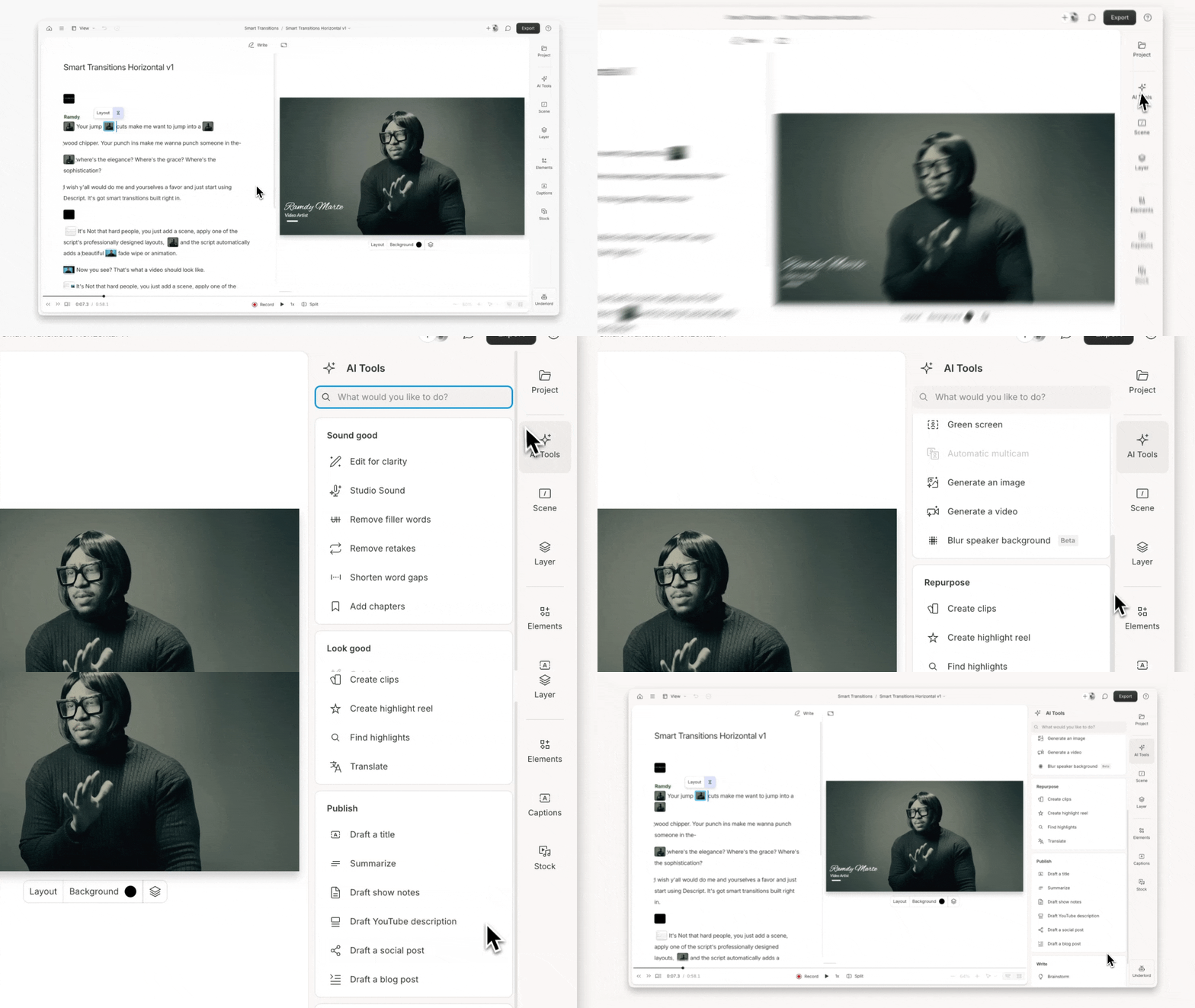
Speaking from experience running a small production company, the collaboration feature is underrated in this article. Being able to leave timestamped comments directly on the transcript is something editors and clients both love immediately.
Okay but can we talk about how OpenAI sending a memo to investors literally complaining about a competitor is such a weird move? That memo reads like a company that's scared, not confident.
Most people can edit a Google Doc. Delete some words, rearrange sentences, fix typos, add paragraphs. It's intuitive and requires no special training. Now imagine editing video the same way. That's Descript's core innovation, and it transformed video editing from a specialized skill requiring expensive software into something anyone who can edit text can do effectively. Descript started as a transcription tool for podcasters. Record your podcast, upload it to Descript, and get an accurate transcript for show notes. But the founders realized something bigger. If you have a perfect transcript synchronized to audio, you can edit the audio by editing the text. Delete a word from the transcript and that word disappears from the audio. That insight became the foundation for a complete editing platform.
Co-opetition is the new normal in AI. Everyone is simultaneously a partner and a competitor with everyone else. Anthropic uses Google infrastructure to compete against Google AI products. Amazon invests in Anthropic while Anthropic uses Amazon chips while also exploring replacements for those chips.
Join independent creators, thought leaders, and storytellers to share your unique perspectives, and spark meaningful conversations.