
Been a fan of Michael Jackson since childhood and I will say this carefully: I can love the music and the artistry and still think a complete biographical film owes the audience the full story. Those two things are not in conflict.
20
Sign up to see more
SignupAlready a member?
LoginBy continuing, you agree to Sociomix's Terms of Service, Privacy Policy

Been a fan of Michael Jackson since childhood and I will say this carefully: I can love the music and the artistry and still think a complete biographical film owes the audience the full story. Those two things are not in conflict.
The technology sector is experiencing a paradox. While headlines scream about mass layoffs at major tech companies, a critical shortage is quietly building in one of the most essential areas of digital infrastructure. Datacenters, the physical backbone of our digital world, are facing an unprecedented demand surge, and there simply are not enough skilled professionals to build and maintain them. Countries across the globe are rushing to establish their own datacenter infrastructure. From India's ambitious plans to become a datacenter hub to the European Union's push for data sovereignty, and emerging markets in Southeast Asia and Latin America building their first large scale facilities, the construction boom is just beginning.

For anyone who has been on the fence about starting manhwa, the current moment is genuinely the best possible time. More series are being adapted and localized than ever before and the quality ceiling keeps rising.
The year 2026 marks a pivotal moment in the evolution of manhwa as a medium. What started as a trickle of Korean comics receiving anime adaptations has become a flood, with at least fifteen confirmed projects bringing beloved manhwa to animated life. This explosive growth wasn't accidental but the inevitable result of Solo Leveling's massive success proving that manhwa adaptations can compete with traditional manga anime in quality, popularity, and profitability. Studios across Japan and Korea are investing heavily in manhwa properties, recognizing that Korean storytelling brings fresh perspectives, innovative premises, and built-in fanbases eager to see their favorite series animated. The diversity of genres receiving adaptations demonstrates that manhwa appeal extends far beyond action and fantasy into romance, psychological thriller, sports, and slice-of-life territories.

Tried explaining it to my partner as a sports story and they asked if the protagonist wins his matches. When I said yes always and easily they asked why anyone should care. That question is basically the thesis of the entire series.
Studio Xtorm is relatively new and unproven on something of this scale, which is my only real worry. The source material is exceptional. Execution is the variable.
The bleakness does not feel exploitative is the thing. It feels like someone who actually understands melancholy trying to render it honestly rather than dramatically.
The meta-agent capability is interesting but also the part that concerns me most from a security standpoint. An agent that can spin up other agents with varying levels of access to your production systems needs very careful guardrails.
The live action film having a 35% audience score on review sites should be a warning sign, not just a footnote. Adapting this material is genuinely difficult and not every format works for it.
Speaking from experience in enterprise software sales: the HeyGen model of low entry price plus natural upgrade path is extremely hard for sales-led companies like Synthesia to replicate. Product-led growth creates a kind of flywheel that outbound sales cannot match at the SMB tier.
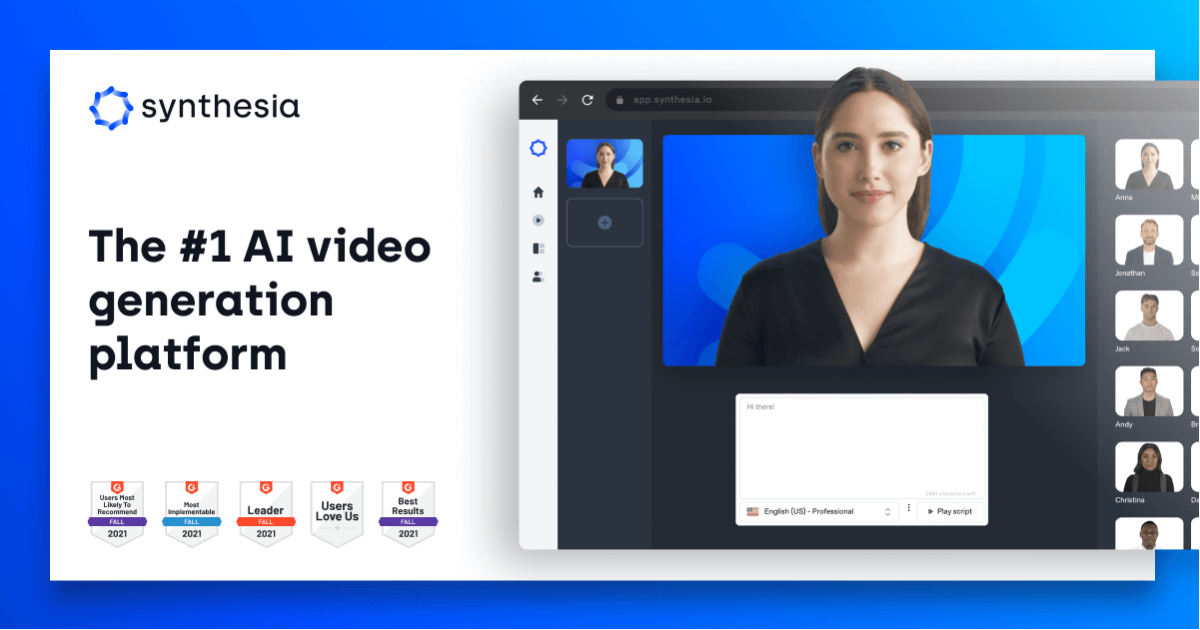
When a company raises $200 million in Series E funding during January 2026, investors are betting on more than potential. They're backing proven market demand and sustainable growth. Synthesia's funding round came alongside a 44% year-over-year increase in headcount to 706 employees, signaling aggressive expansion in a category the company essentially created: AI avatar-based video generation for enterprise training and communications. Corporate training videos have been expensive and slow to produce for decades. Recording a single 10-minute training module traditionally required booking a studio, hiring a presenter, scheduling a videographer, managing multiple takes, and editing everything together. If you needed to update information or translate content, you essentially started over. Synthesia eliminated this entire production workflow by replacing human presenters with AI avatars.
Honestly the productivity angle is oversold a little. The tool saves time for the person who skipped, but everyone who showed up still sat through the full meeting. The meeting itself did not get shorter.
The artificial intelligence industry is entering a new phase of competition, one that extends far beyond the development of advanced language models and neural networks. Companies are now engaged in an intense struggle to secure the computational infrastructure necessary to train and deploy their AI systems. In this context, Anthropic has reportedly begun exploring the possibility of designing and manufacturing its own specialized processors to power Claude, its flagship conversational AI platform, along with its broader suite of artificial intelligence technologies. This strategic consideration emerges at a critical moment in the global AI sector. The exponential growth in model complexity and capability has created unprecedented demand for high-performance computing resources. Sources familiar with the matter indicate that Anthropic is conducting feasibility studies to determine whether developing proprietary semiconductor technology could reduce its dependence on external hardware vendors while ensuring reliable access to the computing power required for its operations.

The requirement that partners share findings with the broader industry is doing a lot of work in this announcement. That is the accountability mechanism that makes the restricted access model defensible, if it is actually enforced.
the era of security by obscurity is over. If AI can find a 27-year-old bug in days, the assumption that legacy undocumented code is safe because nobody knows it exists has to be abandoned permanently.
The competitive dynamics right now are intense. Anthropic apparently released something called Mythos the same week that was so powerful they are only letting a handful of companies access it initially. Meta's moment got big headlines but the frontier is moving extremely fast.
In an extraordinary move signaling growing alarm over artificial intelligence capabilities, US Treasury Secretary Scott Bessent and Federal Reserve Chair Jerome Powell jointly summoned the nation's most powerful banking executives to an emergency meeting this week at Treasury headquarters in Washington, DC. The hastily arranged gathering centered on mounting cybersecurity concerns stemming from Anthropic's latest artificial intelligence system, known as Claude Mythos. The San Francisco-based AI company recently disclosed that its newest model demonstrates unprecedented abilities to identify and exploit software vulnerabilities, raising immediate red flags across the financial sector and national security establishment.

The global cryptocurrency market capitalization has climbed back above the $2.5 trillion threshold, fueled by a massive liquidation of short positions and renewed institutional interest. Geopolitical developments and shifting investor sentiment combined to create a powerful rally that caught bearish traders off guard, resulting in substantial losses for those betting against the market. According to data from CoinGecko, the total market capitalization of all cryptocurrencies combined increased 1.4% to reach $2.52 trillion on Friday, April 10. Bitcoin experienced a notable surge of over 3%, briefly touching the $73,000 mark before consolidating around $72,000 at the time of writing. Ethereum demonstrated equally impressive strength, pushing past the $2,200 level, while the majority of top 10 cryptocurrencies by market capitalization also posted significant gains.

Does anyone else think a deep burgundy lip could work instead of the bright red? I tend to feel more comfortable in darker shades.