9 Reasons Why Self-help Books Are The Scam Of The Century

Most self-help books are a scam. Here's how you are being misled

How many times have you been told that "you can do anything you set your mind to" by an overly enthusiastic speaker or writer? If you've read as many self-help books as I have, then you've most likely heard these encouraging words repeated too many times to count.

With a catchy phrase like that, one would hope that it is at least somewhat true. As uplifting and encouraging as it sounds, unfortunately, it is a manipulative lie. Now, before you write me off as a critical pessimist, hear me out.

If you're looking for self-help, why would you read a book written by somebody else? - George Carlin

Before I continue, I must preface that this article does not apply to all self-help books. There exists a handful of self-help books that actually provide legitimately useful and helpful information. But these exceptions are very rare, so this article applies to nearly all self-help books.

Why Self-Help Books Are a Scam
Source: Unsplash

I've read 20+ self-help books and listened to hundreds of hours of motivational speeches. Here are 9 reasons I've found that self-help books are the scam of the century.

1. Self-help is marketed to vulnerable and desperate people

People who are depressed, lonely, desperate, and hopeless are the very people who will jump on a potential lifeline like starved dogs on a fresh steak. This is the exact audience that the authors of self-help books prey on. 

Not only is there lots of money to be made in selling books to this desperate demographic (see reason #9), but they are also the most vulnerable and susceptible people to believe whatever information is presented to them, so long as it makes them feel good and lifts their spirits for a minute.

As someone who went through a serious depression in his early college years, self-help books and motivational talks quickly became my faux lifeline in that darkness. When you feel hopeless, hearing some encouraging words thrown at you with enthusiasm is practically euphoric.

Were all those books really helpful to my suffering and desperation? They seemed like they worked at the moment because I felt better for a passing minute, but in the long run, they did nothing for me or my mental/financial health.

2. Most self-help content has zero scientific basis

"You can do anything you set your mind to", "see it in your mind and it will become a reality." I've heard a million different iterations of motivational statements like these in all the self-help books and motivational seminars I've invested my time into in the past. They sound nice, but are they even credible statements?

The short answer, scientifically speaking, is no. There is no credibility in mantras like these. In order for a hypothesis to be scientifically credible, it needs to first be scientifically reliable.

Scientific reliability is the process of repeatedly achieving a similar output given the same input. Knowing this, it is entirely impossible to measure the outcome or the process of "manifesting success" in even a single individual. Why? Because there are thousands of other variables to consider when a person achieves success.

So, unless you are willing you bank your whole future purely on superstition and the vague "spirituality" of "manifesting your greatness or success", then go right ahead. For the rest of us, a scientific approach to life is far more viable and realistic.

3. Self-help books are riddled with logical fallacies

The Appeal to authority fallacy is defined as an authoritative figure's word being taken as credible evidence for their argument simply because they are an authority figure.

Self-help books are riddled with "success stories" and how the author went from rags to riches through whatever method the given book is about. This is a common logical fallacy that many people fall for. Just because a person has gone from poor to successful, does not automatically make their words reliable and applicable to anybody. 

The anecdotal fallacy is defined as a point argued with anecdotal evidence as to the basis of the argument. This can include personal stories and experiences being over-generalized which are then incorrectly made applicable to everyone.

This logical fallacy is the entire basis of most self-help books. They begin by telling you their success story and how they accomplished greatness. Then they explain how you can achieve the same results by following the same guidelines. The problem is, anecdotal evidence can never be overgeneralized and reliable to everyone. A hypothesis requires repeated testing in order to be considered reliable.  

Survivorship bias is defined as focusing on successful individuals without considering all those that failed or didn't quite make it.

Self-help books seldom mention the multitudes of people who try their absolute hardest in life, but still, they die without a penny to their name. This demographic is exponentially greater than those who become successful. By setting your focus only on people who gained riches, you are getting an unrealistic sample of the population and being deceived into believing that it is a realistic outcome.  

The appeal to emotion fallacy is defined as manipulating emotions as a tactic to strengthen the potency and efficacy of an argument put forth.

If self-help books are great at one thing, it's motivating people. They do this by saying emotionally charged things that will get your emotions ramped up and cause you to be more likely to agree with or follow the arguments that the book is making. When people are ruled by their emotions, they often have a hard time recognizing logical fallacies or errors that may be present in the arguments put forth; self-help books are guilty of this.

This fallacy is further emphasized by dropping as many f-bombs as possible. There's a psychological reason why so many self-help books have the f-word on the cover. Harsh language stirs up emotions and gets people's attention to what is being said. Whether the arguments are valid or not, strong language garners lots of attention. 

The False analogy fallacy states that because two otherwise unrelated subjects have one thing in common, they must also be related in other ways.

I can't tell you how many times I've heard self-help gurus use sharks, lions or wolves as reference points for how you should behave as a person. While it sounds powerful and uplifting to be called a "lone wolf", "alpha", "lion" or another predator in the wild, it makes no sense to compare humans to these wild animals.

What wild animals do is not a useful reference point for how we should behave. Yes, lions are the king of the jungle, and they hunt their prey down. But you know what else lions do? They kill the cubs of other tribes and forcefully mate with females or else they will kill them if they refuse. Don't fall for the false analogy fallacy, it is nothing more than an emotion-driven manipulation tactic. 

The wishful thinking bias is defined as thinking or wishing for something so much that it becomes a reality. 

Almost all self-help books fall for the trap of wishful thinking. It doesn't matter how much you think about success, it won't come to you if you don't have lots of luck, know the right people, and put in unhealthy amounts of work into achieving it. We all wish that wishful thinking was helpful, but the reality is that it is a delusion that most fall for. Sooner or later reality will come and smack you in the face.

4. Self-help books contradict each other all the time

After reading the 20+ self-help books that I did in my early 20's, I started to notice contradictions in philosophies. One author would tell me to take a nihilistic approach to life by saying that everything is meaningless, so you shouldn't let failure bother you. Another author would tell me that "failure is not an option!" and so on.

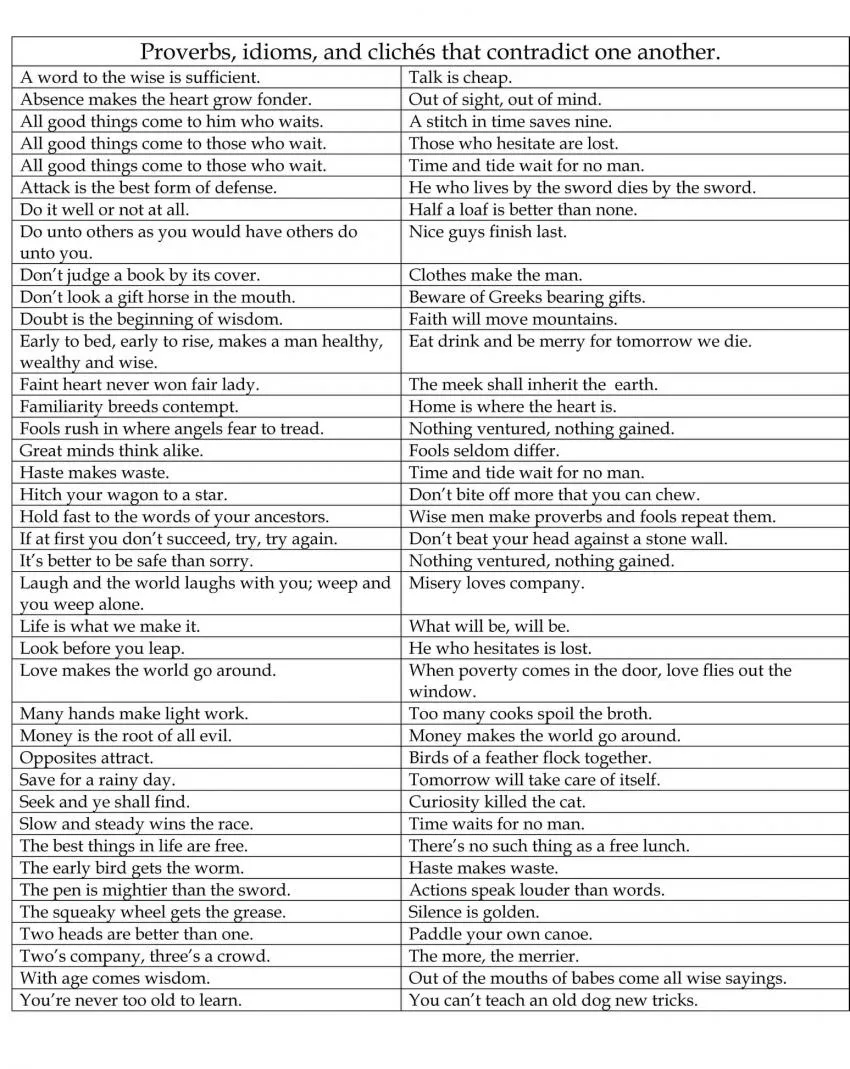
The contradictions are so frequent, that self-help authors even contradict themselves sometimes! I did some research on Reddit and found this, comprehensive list of proverbs, idioms, and cliches that are contradictions to others.

proverbs, idioms and cliches
image source: reddit

With so many different angles to approach self-help from, it will inevitably become nauseating when you no longer know which road to follow because so many people have different opinions and perspectives on how to achieve success.

5. The self-help industry is a money-making behemoth

The self-help industry was worth $9.9 billion as of 2019 and has only grown from there. It is no wonder that the market is flooded with so many books in this genre. Authors and proclaimed "gurus" are often just trying to make a quick buck.

With profits that explosive, people are willing to say or tell people just about anything to get in on the financial gains. The irony here is that most of these people are selling books or programs telling you how to become rich and successful while they themselves are gaining riches solely on the profits made from the book in your hands.

While there are a few legitimate self-help books that aren't written purely for the money, it is no doubt a motivating factor for the majority of self-help authors. Keep this in mind the next time you are deciding to buy a self-help book.

6. Most self-help books can be summarized in a page or two

Let's face it, self-help books are more bloated than an American after leaving a buffet. Most of the information contained in any self-help book can easily be summarized into a single page.

The authors have to add in tons of filler via personal stories, analogies, etc. in order to make a specific page count so they can sell more copies. In reality, their whole philosophy can be refined into one page.

For this reason, self-help books are mostly a waste of your time. Instead of reading through these 200+ page books of filler, just read a blogger's summary article on that book and you will have all the information you need.

7. Self-help is egotistical and self-indulgent

Have you ever seen those Instagram models and influencers who are so full of themselves that they are disgusted by anyone who isn't as successful, beautiful, ripped, or motivated as they are?

Most of these glorified narcissists are products of the self-help industry. These are the people who are constantly posting motivational quotes from self-help books. Why? Because self-help encourages and empowers them to become self-centered and narcissistic.

Unless you think narcissism is attractive and healthy, then think twice about the self-help books you are reading. They might be poisoning your mind into thinking like the Instagram influencers! 

8. Self-help books spread harmful lies

Self-help is infamous for telling people harmful things because it motivates them. I've heard the following statements uttered countless times in different forms:

"you don't need anyone but yourself." 

"you have the power to save yourself."

"if your friends don't make you more successful, get rid of them."

Think logically about statements like these. Do they really seem healthy to you? Sometimes you just need help from others, and that's ok. Friends aren't only there to boost your bank account. These are harmful statements to make. You are a human being, needing other people is part of your nature. We are social beings.

If you follow statements like these as your philosophy, you're likely to end up miserable and lonely. This is how I ended up in my early 20s as a result of these damaging ideas.

I abandoned all my friends because they "didn't help me become more successful" and I also refused help from anyone because I thought that getting help was a sign of weakness and for losers. This all made me extremely depressed, cold, and all alone with nobody to turn to.

No matter what these books tell you, success mostly comes down to luck, being in the right place at the right time, and knowing the right people. You can tell yourself all these lies but without the perfect circumstances, you will be spinning your wheels and harming yourself and others. Get your head out of the clouds before it's too late.

9. Self-help books are addictive and rarely effective

Self-help books are a never-ending addictive disease. It seemed like the more self-help content I consumed, the more I wanted of it. But this inevitably leads you into a downward spiral where nothing gets done and you become addicted to the ideas rather than taking any action.

Reading a book doesn't help anyone if you don't actually take action and do something. Put down the self-help books and get to work if you want to change your life. Don't let other people rule your life with their fancy words. Just... go out there and live!

680
Save

Opinions and Perspectives

AspenM commented AspenM 3y ago

I used to swear by these books but now realize they were just temporary emotional band-aids.

2

The whole industry seems built on making people feel inadequate while promising to fix their inadequacies.

8
KoriH commented KoriH 3y ago

Feel called out by the addiction part. I definitely used reading these books as a substitute for taking action.

1

Learning about survivorship bias changed my whole perspective on success stories in these books.

2

Cannot agree more about the filler content. Most of these books could be condensed into a long blog post.

1
Justin commented Justin 3y ago

The article fails to mention how some people simply need the structure these books provide to start making changes.

0

That section about logical fallacies was eye-opening. I'm going to be much more critical in my reading from now on.

7

Perhaps we need to rename the genre to self-awareness books instead of self-help. Might set better expectations.

5

I've noticed my most successful friends never mention reading self-help books. They just quietly work on their goals.

0

The article makes good points about scientific reliability, but sometimes inspiration doesn't need to be scientifically proven.

5

Started looking through my bookshelf after reading this. The amount of money I've spent on false promises is embarrassing.

6
KaiaJ commented KaiaJ 3y ago

Some valid points but seems like the author had a particularly bad experience with self-help books.

2
AdalynH commented AdalynH 3y ago

The shark and lion analogies always made me uncomfortable. Glad someone finally called out how ridiculous they are.

1
Lila99 commented Lila99 3y ago

Realizing now that I spend more time reading about improving my life than actually improving it.

5

I find it interesting how many people defend these books despite the clear evidence of their manipulative nature.

5

The industry profits are staggering. No wonder everyone and their dog is writing a self-help book now.

3

Just canceled my order for another self-help book after reading this. Going to focus on actual doing instead of just reading.

1

I appreciate how the author included personal experiences to illustrate the points. Makes it more relatable.

1
YvetteM commented YvetteM 3y ago

This article could have been a bit more balanced. Not everyone who reads self-help books is desperate or vulnerable.

2

After reading about the logical fallacies, I started noticing them everywhere in my self-help collection.

2
TomC commented TomC 3y ago

I wonder how many self-help authors actually made their fortune before writing their book about success.

1

The point about refusing help from others hit close to home. I became so independent it was actually harmful.

3

These books do serve a purpose. They get people thinking about self-improvement, even if the methods aren't perfect.

8

Reading this made me realize how much money I've wasted on self-help books that all basically say the same thing.

4

The section about harming relationships really resonated. I lost friends following advice about cutting out non-successful people.

7

Maybe the real scam is expecting any book to completely change our lives without putting in the hard work ourselves.

8

Not all of us can afford therapy. Sometimes these books are the only accessible form of guidance we have.

2

I noticed the same contradictions between books. One says hustle 24/7, another preaches work-life balance.

4

The comparison of self-help addiction to being at a buffet is perfect. You keep consuming but never feel satisfied.

6

I've always wondered why these books need 200+ pages to say what could be said in 20.

6

Fascinating how the article breaks down the logical fallacies. The appeal to emotion one is particularly prevalent.

8

I used to gift self-help books to friends struggling with issues. Now I feel bad about potentially feeding into this cycle.

2

As someone in marketing, I can confirm the emotional manipulation tactics mentioned are very real and deliberate.

7

The author sounds bitter. These books aren't meant to be scientific papers, they're meant to inspire action.

6

That list of contradicting proverbs is eye-opening. How have I never noticed these obvious conflicts before?

7

I've noticed most successful people I know don't read self-help books. They're too busy actually doing things.

1

The article raises good points about predatory marketing, but sometimes people just need a starting point for change.

6

My issue is how these books make everything seem so simple. Real life is much more complex than their step-by-step solutions suggest.

6
Ruby98 commented Ruby98 4y ago

I'm guilty of falling for the wishful thinking bias. Spent years visualizing success instead of actually working towards it.

6
Emma_J commented Emma_J 4y ago

Funny how these books always seem to have the same formula: personal tragedy, breakthrough moment, success, then teaching others.

8

The part about needing other people really hit home. We shouldn't buy into this toxic self-sufficiency narrative.

3
Sloane99 commented Sloane99 4y ago

I wish the article had provided examples of what they consider good self-help books versus the scammy ones.

5
Isabella commented Isabella 4y ago

We shouldn't completely dismiss the genre. Even if 90% is garbage, finding that valuable 10% can be worth it.

7

The point about these books being summarized in a page or two is so accurate. I've started just reading book summaries instead.

2

I appreciate how the article acknowledges that there are some legitimate self-help books out there, even if they're rare.

7

Reading about someone else's success story doesn't guarantee your success. That's the hard truth many people need to hear.

4

The true value of self-help books lies in their ability to make us reflect on our lives, even if we don't follow their advice exactly.

8

Interesting point about the f-bombs in titles. I've noticed this trend too and always found it a bit forced.

1

Just because something isn't scientifically measurable doesn't mean it's not valuable. Sometimes inspiration alone is worth it.

2

The part about scientific reliability really made me think. You can't really measure success manifestation scientifically.

3

I'm currently working through my third self-help book this month and now feeling called out by this article.

1

Anyone else bothered by how these books oversimplify complex life problems into catchy phrases and bullet points?

7

This article feels like it was written by someone who got burned by the industry. There's still value in some of these books if you approach them critically.

8
JocelynX commented JocelynX 4y ago

The addiction aspect is real. I used to buy a new self-help book every week thinking the next one would have all the answers.

3

I understand the criticism but some books genuinely helped me organize my thoughts and set better goals.

8

The bit about Instagram influencers being products of self-help culture is spot on. I see it everywhere now.

3
JohnnyS commented JohnnyS 4y ago

Let's be real, most of these books just repackage common sense with fancy words and success stories.

3
NoraH commented NoraH 4y ago

The $9.9 billion industry figure is eye-opening. No wonder there are so many of these books flooding the market.

7
JonahL commented JonahL 4y ago

My therapist actually warned me about relying too heavily on self-help books. She said they can sometimes do more harm than good.

5

After reading about the logical fallacies, I can't unsee them in every self-help book now. The wolf analogies are especially cringy.

7

I think we're overlooking the fact that different approaches work for different people. What's a scam for one might be valuable for another.

4

The comparison to American buffet bloating made me laugh out loud. So true about these books being mostly filler!

7

This article needs to distinguish between traditional self-help and modern psychology-based personal development books.

2

The part about abandoning friends for success really resonated with me. I almost fell into that trap myself.

1

I actually implemented some strategies from self-help books and they worked for me. It's not about reading, it's about doing.

7

You're missing the point. Hope without action is just delusion. That's exactly what the article is trying to say.

8
JennaS commented JennaS 4y ago

The article makes valid points but seems overly cynical. These books helped me through some tough times, even if just by giving me hope.

8

I found the section about contradicting advice particularly interesting. It's true, one book tells you to embrace failure, another says failure isn't an option.

5

That George Carlin quote at the start is brilliant. Why would you read someone else's book for self-help? Made me laugh and think.

0

Every time I read a self-help book, I get pumped up for like a week, then nothing changes. Glad I'm not the only one experiencing this.

1

The point about logical fallacies opened my eyes. I never realized how many success stories rely on survivorship bias.

0

I disagree with the author's take on scientific basis. Many modern self-help books do cite legitimate psychological research and studies.

2

Anyone else notice how all these self-help gurus seem to make their money by telling others how to make money? The irony is not lost on me.

3

The part about marketing to vulnerable people is so true. I was at my lowest when I got sucked into buying tons of these books.

2

While I agree with some points, I think completely dismissing the entire self-help genre is a bit extreme. Some books genuinely helped me develop better habits.

3

I feel this article really hits home. After spending hundreds on self-help books myself, I realized I was just chasing a temporary emotional high rather than making real changes.

1

#Related

NidhiSingh
lifestyle · 6 min read

4 Tips To Lose A Fight, With Your Outrageous Outer Look To Your Inner Self

Beauty has always been measured inside a very narrow frame. But in reality, the actual potential of beauty is much broader than anyone could ever think of. Beauty is not about all shimmer, brighter colors, and perfection. True beauty stands with the color. Here are the tips to feel confident and beautiful in your own skin. It is imperative to love yourself and embrace what you have. Knowing your own personality and factors which make you unique from others is really the reason to be happy about yourself. This era of digitization might be able to connect everyone digitally but it’s really tough to connect from one’s inner self.

4 Tips To Lose A Fight, With Your Outrageous Outer Look To Your Inner Self by NidhiSingh
516
Save
Lashay Deloach
wellness · 7 min read

Easiest Ways To Boost Your Self-Confidence For Young Women

Is your lack of confidence taking over your life? If so, it's time to boost your self-confidence and experience joy in your life! Life is too short to be unhappy because of your lack of confidence. When you have high confidence, you can tackle any obstacle! You'll feel confident about your imperfections, talents, and you'll think more positively about yourself. With high confidence, you can also build healthier relationships with others. With high confidence, you are willing to try out new things and overcome any fears! Now since we've talked about all of the great things associated with having high confidence, let's get into simple things you can do to build your self-confidence.

Easiest Ways To Boost Your Self-Confidence For Young Women by Lashay Deloach
616
Save
Emily Zane
lifestyle · 11 min read

How To Build Your Confidence In 12 Straightforward Ways

Think of that person you know, the one we all know. He or she exudes an air of certainty, carries themselves with determination, and lives in a way that portrays spirit and tenacity. We all know someone like this, and we aspire to be like them. These are family members, friends, coworkers, neighbors, bosses. Whether it’s you or someone you know, we can all zero in on that someone we’ve come across in our lives who is the epitome of self-confidence. Believing in your abilities, trusting in yourself and your potential, and having faith in your performance and skillset are all characteristics of self-confidence.

How To Build Your Confidence In 12 Straightforward Ways by Emily Zane
231
Save
Emily Zane
lifestyle · 15 min read

18 Ways You Can Take Care Of Yourself Today, This Week, And In This Moment

Throughout the monotony of everyday life, the difficulties and challenges we regularly face, and the mounting stress that is often a byproduct of being an adult, we tend to push self-care aside and opt for instant gratification and immediate relief. We don’t take proper care of ourselves anymore in this obstreperous world, and we instead allow the busyness and unpredictability of life to expropriate the care and nurturance we are entitled to provide ourselves with. Taking care of yourself means that you are providing for your needs in ways that are conducive to enhancing your physical and mental wellbeing. In order to live a fulfilling life, we must satisfy our earthly needs as well as our inherent ones.

18 Ways You Can Take Care Of Yourself Today, This Week, And In This Moment by Emily Zane
896
Save
Emily Zane
wellness · 8 min read

The Five Key Reasons Why You Have A Low Sense Of Self-worth

Self-worth is a concept that’s gained traction and notoriety over the years, increasingly so with the wave of self-care that’s impressed itself upon society by the Millennial and Gen Z generations. We see ads and commercials imploring us regularly to practice appropriate self-care in order to fuel and nurture our self-worth, but before buying into the message, we first need to examine what it means to have self-worth. Before we can dive into the reasons why someone’s concept of self-worth may be lacking, we must first explore and define the term itself. Self-worth is the way you view yourself; it is how you see your value and worth in the world.

The Five Key Reasons Why You Have A Low Sense Of Self-worth by Emily Zane
745
Save
Emily Zane
wellness · 6 min read

The Number One Thing To Keep In Mind When It Comes To Your Self-worth

Social media is constantly throwing the term “self-worth” at us from every direction on a daily basis. We see it in our Instagram newsfeed, we see it trending on Twitter, and we see it highlighted through shared links and content on Facebook. When we think about self-worth, self-care typically comes to mind. Our minds drift to bubble baths with fizzy bath bombs, face masks that penetrate our pores, pampering manicures and pedicures, and indulgent massages that leave us feeling whole and rested. While these acts are only a single facet of self-care, they don’t necessarily fall under the category of self-worth. These two words may belong to the same family, but they are not interchangeable.

The Number One Thing To Keep In Mind When It Comes To Your Self-worth by Emily Zane
102
Save
Emily Zane
wellness · 10 min read

14 Self-empowering Beliefs That Will Strengthen Your Self-identity

As children, we are each taught stories that are unique to us; we are told who we are, what we are, where we’re going, what we’re going to measure up to, who we will be. As children, we are young, malleable, thirsty sponges that soak up the things we’re told. Many of the details that make up these stories are determined by our parents, guardians, culture, demographic, or life circumstances. Our environments and the people in our environments impress their beliefs of who and what we are upon us. Everyone begins life as an infant with an infant brain that develops with time and experience. We start with absolutely zero knowledge of ourselves and the world around us; we absorb the information fed to us and we trust that those older and wiser truly are wiser.



14 Self-empowering Beliefs That Will Strengthen Your Self-identity by Emily Zane
687
Save
Emily Zane
wellness · 6 min read

How To Identify Your Core Beliefs About Your Self-worth

We’re here to talk about all things self-worth, from what it means and how to define it, to how it presents itself, why self-worth looks different for different people, and we’ll explore the reasons behind why we believe the things we believe about ourselves and how those beliefs got there. If you have access to social media and use platforms like Instagram, Twitter, TikTok, etc.; if you watch network TV programs or stream popular shows on Netflix and Hulu; if you flip through lifestyle magazines while waiting at the doctor’s office, chances are you’ve at the very least seen or heard the term “self-worth.”

How To Identify Your Core Beliefs About Your Self-worth by Emily Zane
338
Save

Publish Your Story. Shape the Conversation.

Join independent creators, thought leaders, and storytellers to share your unique perspectives, and spark meaningful conversations.

Start Writing